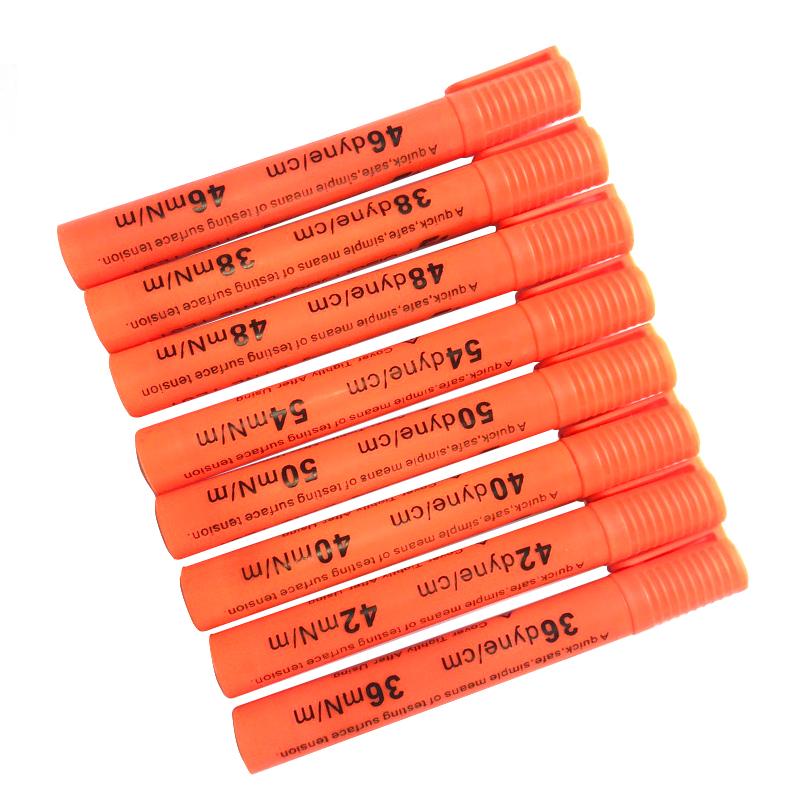
Surface free energy is a measure of the excess energy present at the surface of a material compared to its bulk. It can be used to describe wetting and adhesion between materials, but is not often used quantitatively.
In the bulk form of a material, the atoms are usually stable and have a balanced set of bonds/interactions. Instead, surface atoms will have an incomplete, unbalanced set of interactions and thus unrealized bond energies. Surface energy is a relative measure of surface energy (which is a result of incomplete bonding). It is positively correlated with the strength of bulk interactions and the level of surface exposure. Therefore, if the bulk interactions are stronger, or if the surface exposure is greater, the surface energy will be higher.
A surface will always minimize its energy. This can be done by adsorbing materials with lower energies onto its surface. Through the adsorption process, the number of exposed surface atoms with high surface energy is minimized and replaced by lower energy atoms or molecules. Liquids generally have lower surface energy than solids (due to the weak forces of interaction between molecules), which is why liquids usually spread apart. Surface energy can be defined as the energy required to increase the size of a surface per unit area and is therefore usually quoted in units of mN/m.
Surface energy is primarily used to describe solids. The tendency of a solution to spread (or "wet") on a solid surface depends on several factors. It is assumed here that liquids and solids are capable of similar polar interactions.
Typically, a surface with low surface energy results in poor wettability and thus high contact angles. This is because surfaces cannot form strong bonds, so liquids have little energetic incentive to break bulk bonds in favor of interacting with surfaces. Typical surfaces with low surface energy include hydrocarbons because they are held together by weak van der Waals forces. High surface tension liquids can also cause this, since it's more conducive for a solution to stay bound to itself.
High surface energy is the opposite, which generally results in good wetting and low contact angles. Examples of surfaces with high surface energy include glasses, ceramics, metals, and materials held together by stronger bonds (such as ionic, covalent, and metallic). Low surface tension liquids also result in low contact angles - because the interactions within the liquid are not as strong.