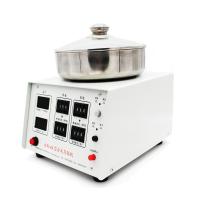
In spin coating, a solution is dispensed onto a flat substrate that has been spun or subsequently started to spin. The centripetal force shears the solution, spreading it evenly across the surface as a thin film. The thickness of the deposited film is determined by the applied shear force, which is proportional to the rotation rate.
advantage
A simple and effective process that requires minimal training to master.
Coats small, flat substrates very well.
Uniform films with a wide range of thicknesses (nanometers to micrometers) can be achieved.
Fast drying times (due to substrate rotation) mean that films can be created very quickly.
Post-deposition heat treatment is not always necessary, since the airflow generated by the rotation is sufficient to dry the film.
The airflow generated during film rotation helps to even dry.
Of all these methods for making individual thin films, it is the most cost-effective one because it does not require any high-energy processes.
shortcoming
The main limitation of spin coating is that it is only effective for the coating of small substrates and only for batch processing. Spin coating is not at all suitable for large-scale production, so this limits its application in research and development.
During the spin coating process, a large amount of ink came off. This process has a high level of solution waste. Additionally, this can make low concentration solutions difficult to apply.
Does not form thin films on curved surfaces and is difficult to use when coating flexible surfaces.
Cannot produce gradient thicknesses on films - produces films of uniform thickness.
The drying times involved in spin coating are usually short and therefore not suitable for processes requiring extended drying times.
ideal use
Spin coating quickly and reliably produces uniform thin films on small surface areas. It is ideal for laboratories that research and develop various thin film technologies. Furthermore, spin coating is cost-effective and easy to set up and use, making it popular in a wide range of research fields. Spin coating is commonly used to process photoresists and thin-film electronic devices (such as photovoltaics and light-emitting diodes) on wafers.