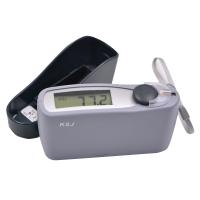
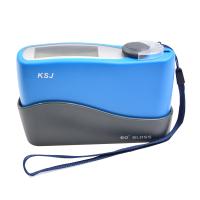
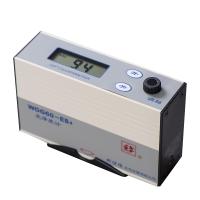
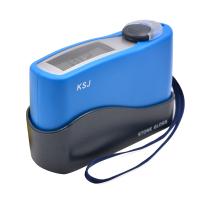
The gloss of the coating film can be measured according to the method in the national standard GB/T9754-1118 "Paints and varnishes - Determination of 20°, 60° and 85° specular gloss of paint films without metallic pigments". This standard is equivalent to the international standard ISO2813-]978 "Paints and varnishes - Determination of 20°, 60° and 115° specular gloss of intercolor paint films without metallic pigments".
This standard specifies the method for measuring the specular selectivity of paint films at geometric angles of 20°, 60°, and 85°.
The 60° gloss measuring instrument is suitable for all colored paint films, but for colored paints with a high f)t or near matte slickness, the 2° or 85° rule is more suitable.
The 2o° gloss meter can improve the ability to sort high-gloss paints, and is suitable for paints with a 60° gloss higher than 70 units.
The 85° gloss meter can improve the identification ability for low-gloss paints, and is suitable for paints with a 60° gloss lower than 30 units.
These methods are not suitable for the manual determination of the sheen of paints containing metallic pigments.
(1) Instrument
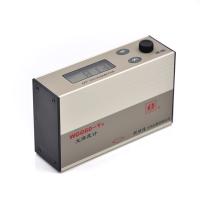
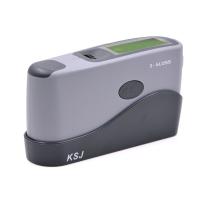
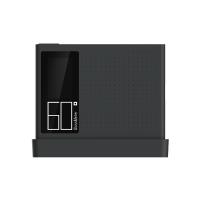
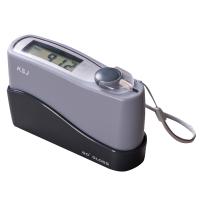
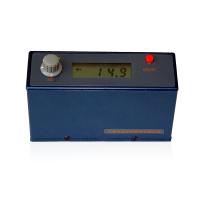
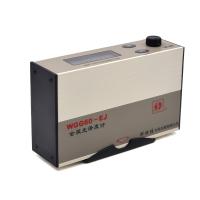
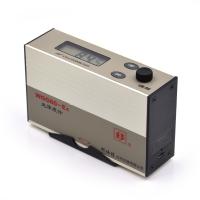
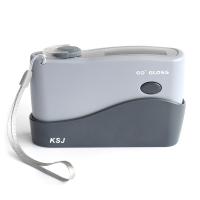
①The gloss meter is composed of a light source part and a receiving part. The light source passes through the lens to make parallel or slightly converging light beams shoot to the surface of the paint film of the test panel. The reflected light is converged by the lens of the receiving part, and absorbed by the light pool through the field of view diaphragm.
②Standard plate
(2) Test method
① At the beginning of each operation, first adjust the instrument and calibrate the gloss meter so that it can correctly read the gloss value of the high- gloss working standard plate, and then read the gloss value of the low-gloss working standard plate. If the instrument reading of the low-gloss working standard plate differs from the specified value by more than 1 gloss unit, it is recommended to be readjusted by the instrument manufacturer before use. After using for a certain period of time, it is also necessary to calibrate the gloss meter to ensure that the instrument works normally and stably.
② After the gloss meter is calibrated, take 3 readings at different positions on the surface of the test paint film parallel to the coating direction, and then calibrate the instrument with a high-gloss working standard plate to ensure that the readings If the error range of the result is less than 5 units, record the average value as the specular gloss value. Otherwise, perform 3 more measurements quickly, and record the average and limit values of all 6 numbers.
③Using this method to measure gloss is meaningful only on paint films with good surface smoothness. Because if the substrate is slightly curved or locally uneven, it will seriously affect the measurement results.