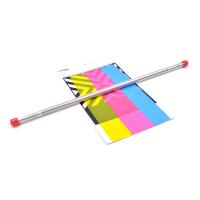
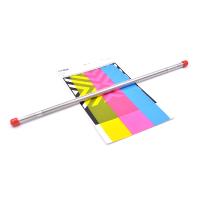
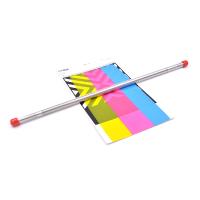
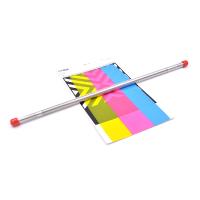
Wire bar coating (also known as Meyer rod coating) is very similar to drawdown blade. Place excess solution on the substrate and spread it through the strip. The wand is a spiral Film Applicator, essentially a long cylindrical wand with a wire coiled around it.
The gap between the wire and the substrate determines how much solution is allowed to pass through. This then determines the film thickness.
advantage
The process is inexpensive and simple to use, while producing consistently uniform films.
Multi-line and special-line designs allow you to vary film properties such as thickness without changing the chemical composition of the coating material or completely overhauling the system.
The drying time is controllable. Suitable for cases where time is required to form thin film structures.
This process is easily scalable.
Uniform films can be formed on large areas of rigid or flexible substrates.
shortcoming
The thickness of the film is limited by the diameter of the wire, which results in a minimum thickness of about 10 microns.
Patterning cannot be done using this technique. Only a uniform film can be formed on the substrate.
Any contamination within the system can cause streaks to form in the wet film as the rod is drawn closer to the substrate
Thickness depends on rod structure and solution properties.
Coating speed is slow. The maximum speed depends on the rate at which the gap is filled by capillary force.
ideal use
The scalability and simplicity of this technique make it very attractive to both the research and manufacturing sectors. Plus, the technique is easy to adapt, making it a sensible choice for experimentation. The technique shares many similarities with drawdown blades while retaining the added simplicity and repeatability thanks to the fixed coating thickness bars. Due to the similarities between coating methods, this technique is often used in the same fields as drawdown blade coating.