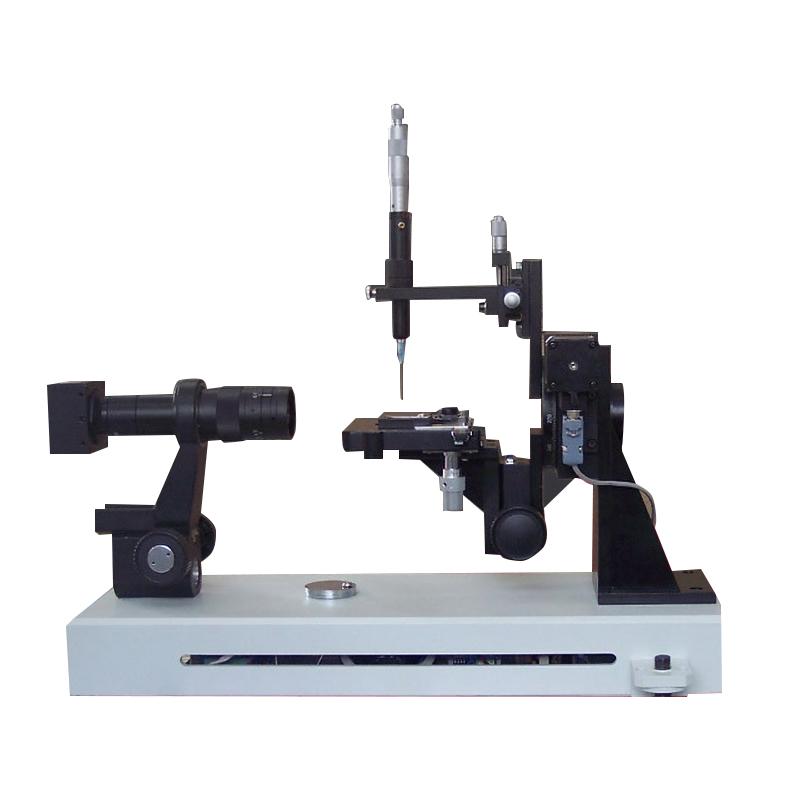
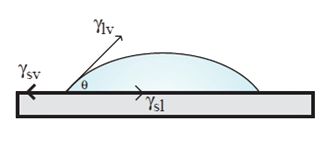
The contact angle (θ) is the angle formed by a small drop of liquid when it meets the surface or interface of another phase (usually a solid)
Force balance at contact angle (θ):
Young's equation: In equilibrium, γ sv = γ sl + γ lv cosθ
In the formula, γ lv is the equilibrium between the liquid and its own vapor, γ sv is the equilibrium between the solid and its own vapor, and γ sl is the equilibrium between the solid-liquid interface.
Static contact angle:
The contact angle is measured arbitrarily after dispensing of a droplet resting on a solid surface with no movement of the three-phase boundary, often referred to as the static contact angle.
Dynamic contact angle:
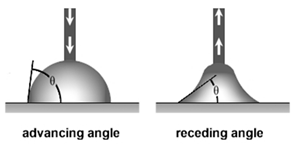
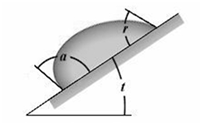
The time-dependent measurement of the static contact angle as the three-phase boundary moves is called the dynamic contact angle. There are two types of dynamic contact angles known as advancing contact angle and receding contact angle. The dynamic contact angle can be measured using two different methods; changing the volume of the droplet or using a tilting stand.
propulsion angle
By dynamically adding liquid to the droplet, the maximum contact angle θa is possible without increasing the area of the solid-liquid interface.
receding angle
If you start removing volume in the above situation, then the smallest possible angle is called the receding angle θr
Lag angle
The lag angle (θ H ) is the difference between the advancing angle (θ a ) and the receding angle (θ r ). θ H = θ a - θ r
Inclined plane method
The inclined plane method gives both advancing and receding contact angles in the same droplet. Droplets are placed on the substrate and then gradually tilted. The advancing angle is measured at the front of the droplet, just before it starts moving. The receding contact angle was measured at the same time point on the back of the droplet.