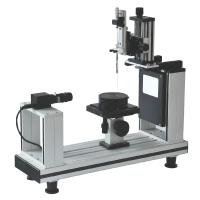
Measurement
1. Sample preparation
Samples with good surfaces should be prepared in advance and their surfaces should be properly cleaned before measuring the contact angle. It should be placed completely horizontal. Thorough cleaning of syringes and stainless steel needles is required. However, it increases the wettability of the steel by the liquid; therefore, the liquid (polarity) released from the needle may climb upwards on the outer surface of the needle during the contact angle measurement. To counteract this effect, the liquid repellency of the needle tip needs to be enhanced by rubbing the needle tip in Parafilm.
2. Ensure humidity/steam level conditions
The sample should be placed in a measuring cell partially filled with probe liquid and covered to saturate the phase. This should usually happen a few minutes before taking the contact angle measurement. A syringe filled with probe fluid should be installed at this stage with the needle pointed above the sample surface.
3. Measurement of static contact angle
A small droplet should be deployed on the sample surface with the needle on top of the deposited droplet. The diameter of the deposited droplet (or its base) should increase to at least 3-4 times (>5-7 mm) the diameter of the needle used - the supply of liquid should be continued until a clear spread of the droplet base is observed. The needle should be removed from the droplet and wait 1-3 minutes. The droplet is stabilized and then the static contact angle is measured.
4. Measurement of advancing contact angle
The needle should be brought back over the deposited drop (or close to it) and more liquid should be added until the bottom of the drop spreads out again. Remove the needle and immediately measure the advancing contact angle. Repeat this step 3-5 times and take the average value.
5. Measurement of receding contact angle
After the advancing contact angle measurement is complete, the needle is dipped into the droplet to draw out the liquid and reduce the droplet size. The droplet diameter should be observed during liquid extraction. The needle can be detached from the droplet and the receding contact angle can be measured after the diameter of the droplet base shrinks during liquid withdrawal. Repeat this step 3-5 times and take the average value.
6. Reproducibility
Contact angle measurements should usually be repeated at three to five different locations on the sample or on different samples of the same type and subjected to the same cleaning procedure.
Problems and Considerations in Contact Angle Measurement Liquid Penetration of Surfaces
Liquid Dissolving Surface
liquid contamination
Droplet Size and Gravity Effects
evaporation
Usually limited to ambient temperature
Usually limited to flat
Surface roughness
surface heterogeneity
Surface group mobility and kinetics
Advancing and receding contact angle
Limited to relatively low energy solids (polymers)
Personal eyeball "bias"