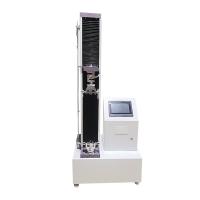
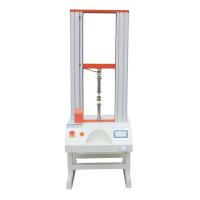
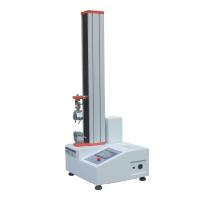
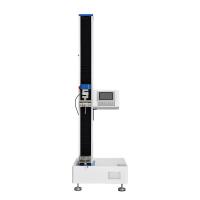
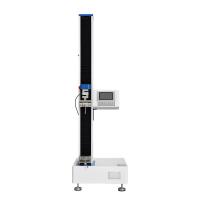
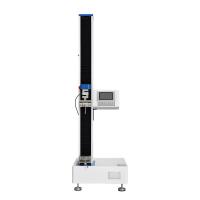
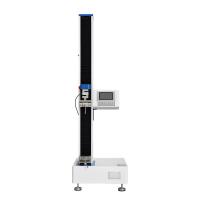
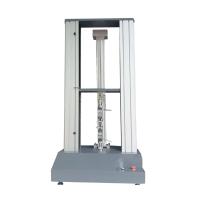
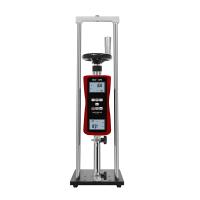
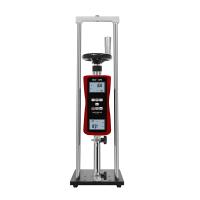
Tensile testing machine is a large-scale precision testing instrument combined with modern electronic technology and mechanical transmission technology. It gives full play to the characteristics of mechatronics and has the characteristics of wide measurement range, high precision and fast response. The Tensile Testing Machine works reliably and effectively, and can display, record and print test data in real time. It consists of measurement system, drive system, control system and computer structure.
Force measurement
Force is measured with load cells, amplifiers and data processing systems. Commonly used load cells are strain gauge sensors.
The strain gauge sensor is a device composed of strain gauges, elastic elements and certain accessories (compensation elements, shielding covers, terminal blocks, loading parts), which can convert a certain mechanical quantity into electrical output. There are many types of strain gauge sensors, mainly barrel-shaped force sensors, spoke force sensors, S-shaped double-connected hole sensors, and beam-type sensors.
It can be known from the mechanics of materials that the strain Ɛ at a certain point of the elastic element is proportional to the force exerted on the elastic element, and is proportional to the deformation of the elastic element under the condition of small deformation. For example, when the sensor is subjected to tension P, the strain gauge is attached to the surface of the elastic element, because the strain on the elastic element is proportional to the magnitude of the external force P, therefore, the strain gauge is connected to the measurement circuit, and the output voltage can be measured to determine the force .
For force sensors, a differential full-bridge measurement is generally used, in which strain gauges are connected to form a bridge circuit. In simple terms, the external force P causes deformation of the strain gauge in the transducer, resulting in an unbalanced bridge, which causes a change in the output voltage of the transducer.
Generally speaking, the output signal of the sensor is very weak, generally only a few millivolts. If this signal is directly measured, it is very difficult and cannot meet the requirements of high-precision measurement. So this weak signal needs to be amplified by an amplifier which amplifies the signal voltage to 10V. At this time, the signal is an analog signal, and the analog signal is converted into a digital signal through a multi-way switch and an A/D conversion chip, and then the data is processed, and the force measurement is over.
The quality of the sensor determines the accuracy and stability of the tensile machine. Currently, for tensile machines with sensors on the market, S-type sensors are generally used for small force values, and spoke-type sensors are generally used for large force values. The internal sensor is generally a resistance strain gauge type. If the precision of the strain gauge is not high or the aging resistance of the fixed strain gauge glue is poor, or the material of the sensor is not good, the accuracy and service life of the sensor will be affected. TESTEX tensile Tester uses a familiar sensor, the accuracy High, good linearity, very stable, will not change for decades.
Deformation and beam displacement measurements
This is measured by a deformation measurement device used to measure the deformation of the specimen during the test.
The device has two chucks that are connected by a series of drives to an optical encoder mounted on top of the measuring device. When the distance between the two brackets changes, the shaft of the photoelectric encoder rotates, and the photoelectric encoder outputs a pulse signal. This signal is then processed by the microcontroller to give the amount of deformation of the specimen.
The measurement principle of the beam displacement is roughly the same as that of the deformation measurement, and the displacement of the beam is obtained by measuring the pulse number output by the photoelectric encoder.
The transmission is mainly completed by the lead screw. If there is a gap in the lead screw, the tensile test will directly affect the maximum test deformation and elongation after fracture. Some Tensile Testing Machines currently on the market use T-shaped ordinary screws, so the gap is relatively large and the friction is relatively large, resulting in a short life. The screw used in the TESTEX Tensile Testing Machine is a high-precision backlash-free ball screw with a high surface quenching hardness, a service life of up to decades, and the same accuracy.
Tensile testing machine drive system
The drive system is mainly used for the movement of the beam of the material testing machine. Its working principle is to control the motor through the servo system, and the motor drives the screw to rotate through a series of transmission mechanisms such as the reduction box, thereby controlling the movement of the beam. By changing the speed of the motor, the moving speed of the beam can be changed.
At present, some Tensile Testing Machines on the market use ordinary three-phase motors or variable frequency motors. This type of motor is controlled by analog signals, with slow control response and inaccurate positioning. Generally, the range of speed regulation is narrow. There are high speeds but no low speeds or low speeds without fast speeds. Inaccurate. The motor used in the TEXTEX tensile machine is a full-digital AC servo motor. The control method adopts full-digital pulse control. The speed range is wide, up to 0.01-1000mm/min. The control positioning is accurate and the response speed is fast. The motor can ensure accurate speed regulation in the full range. Use Long life, up to decades.
Tensile testing machine control system
As the name suggests, it is a system that controls the operation of the computer servo system of the material testing machine. People can control the operation of the testing machine through the console, and understand the status of the testing machine and test parameters through the console. exhibit. If the machine is equipped with a computer, it can also realize various functions, perform data processing and analysis, and print test results. The communication between the Tester and the computer generally adopts the form of RS232 serial port communication, through the serial port (COM number) on the back of the computer, which is a mature, reliable and easy-to-use technology.
At present, the measurement and control system of most tensile Testers on the market is controlled by 8-bit single-chip microcomputer, which has a low sampling rate and poor anti-interference ability. In addition, if the resolution of the number of digits of the AD converter is also low, the measurement will be inaccurate.