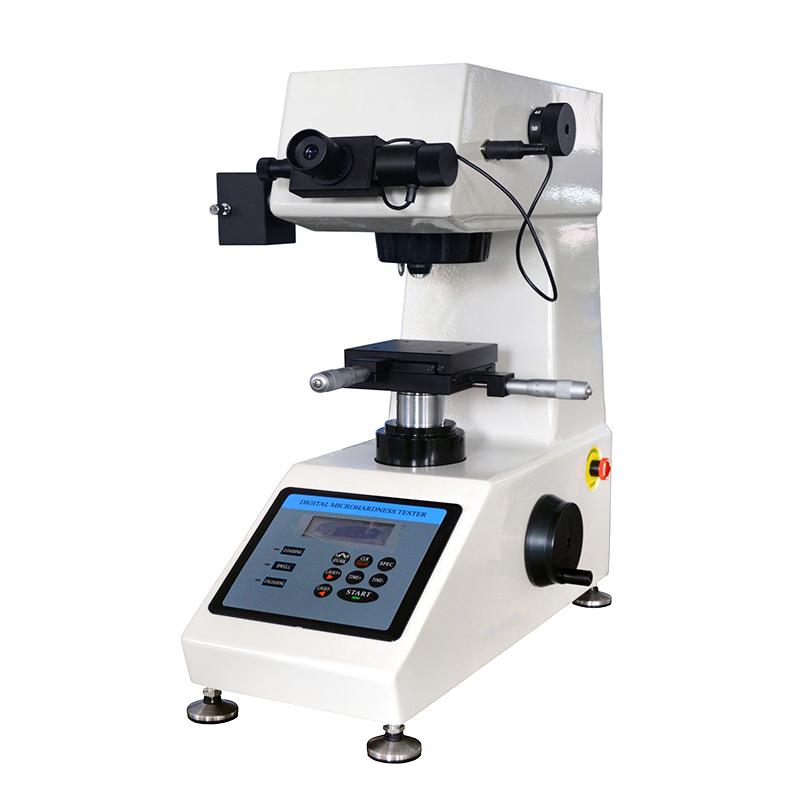
Priority should be given to the following sample characteristics before selecting the hardness testing method to use:
sample size
cylindrical sample
Sample thickness
scale
Equipment reproducibility and repeatability
sample size
The smaller the part size, the lower the load to create the required indentation. For small part sizes, it is important to meet minimum thickness requirements and keep indentations away from internal or external boundaries. Larger parts need to be properly secured with proper fixtures to ensure they do not move or slip during testing. Those parts that protrude from the anvil or are not easily supported by the anvil should be clamped in place or properly supported.
cylindrical sample
Due to the difference in axial and radial material slip, the test results need to be corrected when testing small diameter cylindrical samples. According to the diameter of the cylindrical convex surface, arc correction parameters are added to the test results. Also, it is important to maintain a minimum spacing equal to approximately 2 to 1/2 times the diameter of the indentation from the edge or another indentation.
Sample thickness
The minimum thickness of the sample should be at least ten times the depth of the indentation. Both ordinary and superficial Rockwell methods have minimum thickness requirements.
scale
Sometimes it is necessary to measure on one scale and report on another. A transfer function is necessary, but it is important to note that it may not provide reliable information unless actual correlations are done through testing across different scales.
reproducibility and repeatability
Equipment repeatability and reproducibility studies are used to calculate the ability of an operator and an instrument to perform a test within tolerances for a specific test sample. Hardness testing also has inherent variables that are excluded by standard equipment R&R procedures and formulas for actual test samples. Variations in material and the inability to test in the same area using a depth gauge are two important factors that affect GR&R results. To minimize these effects, research high-consistency standard blocks to minimize these built-in changes.