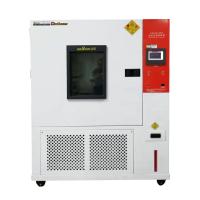
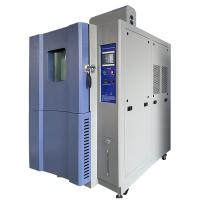
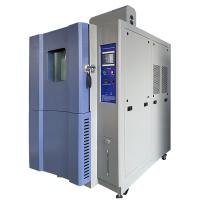
Components are the basis of the whole machine. Failures related to time or stress during use may occur due to inherent defects in the manufacturing process or improper control of the manufacturing process.
In order to ensure the reliability of the whole batch of components and meet the requirements of the whole machine, it is necessary to eliminate the components that may have initial failure under the conditions of use. The process of component failure rate changing with time can be described by a failure rate curve similar to the "bathtub curve". As time increases, the early failure rate drops rapidly. The failure rate is essentially constant over the lifetime (or during unexpected failures).
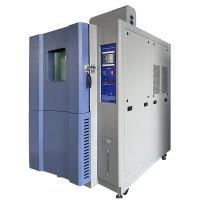
1. The high-low Temperature Test Chamber is used for high temperature storage
Most of the failures of electronic components are caused by various physical and chemical changes in the body and surface, which are closely related to temperature. After the temperature rises, the chemical reaction speed is greatly accelerated, and the failure process is also accelerated. Defective parts can be exposed and eliminated in time.
High-temperature screening is widely used in semiconductor devices, which can effectively eliminate devices with failure mechanisms such as surface contamination, poor bonding, and oxide layer defects. Typical storage time is 24 to 168 hours at maximum junction temperature.
High temperature screening is simple, inexpensive, and can be implemented on many components. After high-temperature storage, the parameter performance of components can be stabilized and the parameter drift in use can be reduced.
2. High-low Temperature Test Chamber is used to screen power and electrical aging
In the screening process, under the combined action of thermoelectric stress, various potential defects on the body and surface of components can be well exposed, which is an important item for reliability screening.
Various electronic components are usually aged for several hours to 168 hours under rated power conditions. Some products, such as integrated circuits, cannot change the conditions casually, but can use high-temperature working methods to increase the working junction temperature and reach a high-stress state.
Power aging requires special testing equipment, which is costly and the screening time should not be too long. Civilian products are usually several hours, military high-reliability products can choose 100, 168 hours, aviation-grade components can choose 240 hours or even longer cycle.
3. Temperature cycle of high-low Temperature Test Chamber
Electronic products will encounter different ambient temperature conditions during use. Under the stress of thermal expansion and contraction, components with poor thermal matching performance are prone to failure. Temperature cycle screening uses thermal expansion and contraction stress between extreme high temperature and extreme low temperature, which can effectively eliminate products with thermal performance defects. The commonly used screening conditions for components are -55°C to +125°C, with 5 to 10 cycles.