I. Overview
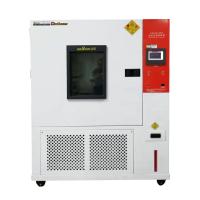
The high-low temperature humidity Test Chamber is a kind of equipment that can be used for reliability testing of lithium batteries, small electronic products, electronic components and materials, or climate testing of other products. The temperature adjustment range of the high-low temperature humidity and heat laboratory is generally +60°C~-50°C, the relative humidity adjustment range: within +20°C~+40°C, the humidity is 50%~95%RH; +40°C~+60°C, Humidity 30%~95%RH. Due to the large temperature range and low negative temperature, the refrigeration system in the laboratory is relatively complicated, so the conventional relay control and manual operation mode is not only complicated, but also inconvenient to operate. High-low temperature laboratory control system designed with wet and dry bulb temperature control table and PLC, which can be operated manually and automatically. It is not only simple in circuit, but also easy to operate. The control system is described below.
2. Cavity structure and working principle
The laboratory is mainly composed of a box, a heater, a humidifier, a refrigeration system and an air supply system. The method of balancing temperature and cooling capacity is used to adjust and control the dry and wet bulb temperature of the air, and the air distribution form of the return air under the full-hole plate air supply, and then obtain the air temperature and humidity required for the test and meet the accuracy required by the test.
3. Control strategy
The heaters in the laboratory are controlled in two groups. One group is the main heating, adjusted by the dry bulb temperature controller PID, the output power is automatically controlled, and the output is 0~100% (electric heating power); the other group is the auxiliary heating, which is started and stopped manually or automatically by the program. It is mainly used when the heat provided by the main heating cannot meet the test requirements. Like heaters, humidifiers are also divided into two groups. One group is the main humidifier, adjusted by the wet bulb temperature controller PID, the output power is automatically controlled, and the output is 0~100% (electric humidification power); the other group is the auxiliary humidifier, which is manually or automatically controlled by the program. It is mainly used when the humidity provided by the main humidifier cannot meet the test requirements. The laboratory refrigeration system is a cascade refrigeration system composed of two cryogenic compressors. There are nine solenoid valves in the system. Different combinations of refrigerators and solenoid valves produce different cooling capacities. The refrigeration system can be divided into five grades according to the cooling capacity. There are nine solenoid valves in the system. Different combinations of refrigerators and solenoid valves produce different cooling capacities. The refrigeration system can be divided into five grades according to the cooling capacity. There are nine solenoid valves in the system. Different combinations of refrigerators and solenoid valves produce different cooling capacities. The refrigeration system can be divided into five grades according to the cooling capacity.
automatic control strategy
According to the working principle of the laboratory, the refrigeration system usually works at a certain refrigeration level and inputs a relatively stable refrigeration capacity. The input of main heating and main humidification is automatically adjusted by the wet and dry bulb temperature control table. When the main heating or main humidification power is insufficient, start the auxiliary heating or auxiliary humidification. When the cooling capacity is reasonably matched with the heating capacity and humidification capacity, the system will quickly reach a dynamic equilibrium, and the temperature and humidity in the laboratory will also stabilize quickly. Whether the cooling capacity put into the refrigeration system is more or less can be analyzed indirectly by observing the output parameters of the temperature and humidity control table. If the value of the output parameter out is large (100%), it means that the temperature and humidity of the laboratory are still lower than the set value, indicating that the cooling capacity input is too much. If the out value is very small (0%), it means that the temperature and humidity in the laboratory are still higher than the set value, indicating that the cooling capacity input is too small. It can be seen that the output parameters of the temperature and humidity control table can be used as the basis for the automatic control of the refrigeration stage. Indicates that the cooling capacity is too low. It can be seen that the output parameters of the temperature and humidity control table can be used as the basis for the automatic control of the refrigeration stage. Indicates that the cooling capacity is too low. It can be seen that the output parameters of the temperature and humidity control table can be used as the basis for the automatic control of the refrigeration stage.
4. System functions
(1) Manual and automatic switching function, select on the control panel. When manual operation is selected, each switch button can be directly operated on the panel. However, due to the different input volumes of heating, humidification, and cooling under different working conditions, experienced personnel are required to operate. When automatic is selected, all equipment switches are turned on, and the actual input of heating, humidification, and cooling is controlled by the program, and the operation is simple.
During operation, if the self-controlled temperature and humidity are stable for a long time, the panel switch can be used to interfere. For example, when going from low temperature to high temperature, according to the automatic control strategy, the cooling level will decrease step by step, requiring a certain delay time. At this time, you can directly turn off all the refrigerators and reheat. When the temperature is close to the set value, turn on the refrigerator switch again, controlled by the program.
(2) The test time can be set manually. After the test, turn off the machines one by one. After the chiller, heater, and humidifier stop, the fan continues to run for 2 minutes and then stops to blow out the hot and humid gas in the air-conditioning cabinet to prevent the equipment in the air-conditioning cabinet from rusting.
(3) Safety protection and alarm function.
The system control circuit has conventional safety protection functions such as overload, undervoltage, open circuit, and power shortage. The chiller is a water chiller, and a water flow protector is installed in the cooling water pipeline. When the water flow is lower than a certain set value, the water flow protector will act and the chiller will stop. In addition, the chiller has oil pressure protection, temperature protection, high-low pressure protection, etc., and the laboratory has high temperature protection function. If the temperature is higher than a certain temperature, all devices will automatically cut off to prevent fire. The humidifier has the function of preventing dry burning. The entire system has complete protection functions, and there are sound and light prompts at the same time.
V. Summary
The above control system has been applied in the equipment, and the automatic control effect is good. The temperature and humidity stabilization time under automatic control is slightly longer than that under manual control, but it meets the stabilization time required by the contract. After the temperature and humidity are stabilized, the fluctuation range meets the test requirements and reaches the design accuracy. Due to the simple operation, it is more popular with operators, and the utilization rate of automatic control is also relatively high.