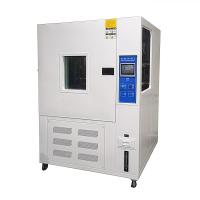
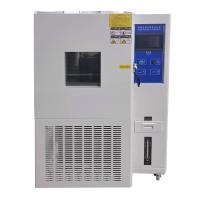
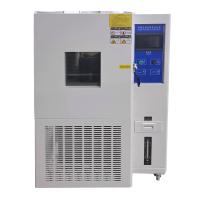
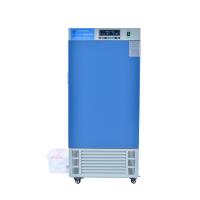
How does the Humidity Chamber simulate various temperature and humidity natural environments?
The constant temperature and Humidity Chamber is usually called a temperature and Humidity Chamber, which is suitable for testing products such as electrical equipment, household appliances, food, trolleys, vulcanized rubber, plastic rubber, metal and other materials. A range of natural environments in terms of temperature and humidity can be simulated indoors. The goal of the entire humidification process is to increase the working pressure of the indoor water vapor.
A temperature chamber is used as a Test Chamber to simulate the settings a product may encounter during use, while evaluating the effect of different environmental variables on a product, component, part or assembly. Conditions in the environmental chamber are managed by computer monitors and can be configured to change conditions rapidly or slow them down for extended periods of time.
Test specifications and standards are prescribed in order to provide accurate information about the performance of a product in a variety of situations that may be encountered in typical use. The testing standards are usually more stringent than the conditions under which the product is normally used.
How does an environmental chamber work?
Depending on its intended application, Test Chambers employ a variety of techniques to establish and maintain environmental conditions.
heating
In modern Test Chambers, the air is heated using an electric heating system to provide accurate, regulated results. This is achieved using a self-contained, fast-response nichrome heater with a ceramic core. Standard models can reach temperatures of 120 degrees Celsius and beyond with an accuracy of +/-0.5 degrees. When heating and cooling it is important to keep in mind the level of performance required of the Test Chamber. Standard versions are available for high-low temperatures. At the same time, these extremes or changes in speed can exceed its capacity without damaging the smaller compressor. When testing your product, always consider how quickly it absorbs heat. Performance expectations will be affected by this.
humidity
Each Test Chamber is equipped with a steam generator dedicated to supplying humidity. They need a well-prepared water source to achieve humidity levels between 20% and 95% relative humidity (RH). To remove unwanted moisture and speed up the pull-down process, mechanical dehumidification systems are often used. Some Test Chambers maintain tight humidity control even as temperatures change. Users who need to achieve relative humidity levels as low as 5%. RH compressors use desiccant air dryers to Test Chambers. When testing your product, always consider how quickly it absorbs heat. Performance expectations will be affected by this.
salt spray
Salt spray is created by preparing and maintaining a salt solution in tanks. It is then driven through a nozzle using compressed air, creating a fine mist in the Test Chamber. During testing, the product was fully visible thanks to its transparent walls.
What is the Humidity Chamber used for?
At various stages in the product development process, companies test the impact of the environment. For newer businesses, it's an essential part of proof-of-concept and prototyping. Testing speeds up their time to market by validating their new concepts to experienced users. While it's important to emphasize that you should spend more time identifying potential weaknesses throughout the R&D process, different stages require different test profiles. It costs much more to fix them, both in production time and financially.
The importance of research to advancing the technical and engineering tasks required for product design and development cannot be overemphasized. Businesses in nearly every industry use research and development to develop, produce and distribute cutting-edge products. Environmental chambers are used in many R&D projects.
Some of these are designed for laboratory research, testing to identify or evaluate product alternatives, developing and testing pre-production prototypes, and other similar purposes. A common test is one that checks the shelf life of a product. Through what is known as extremely accelerated life testing (for example, a 5-degree change in a Test Chamber is equivalent to two years in real-world conditions) the goal is to identify so-called product "failure points" so that companies can set expectations, or focus if necessary Different designs to prove more durable. The more time, money and effort you invest in R&D testing, the more confident you can be in production.
Production
Companies use various production testing methods depending on the product and industry. Everyone needs to run smoothly as planned because they all have the potential to save lives. In several industries, there is a real need for individual product testing. Companies often test products just off the assembly line. However, to save time and money, some people test multiple product batches at once. Regardless of the method, the concept is the same. Before launching your product into the wider market, you need to make sure your product is reliable and of high quality. Testing also demonstrates the time and money invested in research and development.
QC
Does the product work the way it should?
That's what you're trying to discover during quality testing. Quality Assurance and Control provides assurance of the quality of the product. Unique environmental quality standards apply to a wide variety of products, parts and assemblies across many industries. These standards may be implemented by government or commercial agencies, or they may be an important part of a company's design or manufacturing specifications.
reliability check
At this stage, context actually matters. Electronics manufacturers, in particular, test their products to ensure they will work in a variety of environments, including high-low humidity and extreme temperatures. Their expectations and consumer recommendations are guided by results. Reliability testing also reduces the likelihood of unplanned, costly product failures after product release.
What should you do if the Humidity Chamber won't open?
The device is powered by a three-phase 380V and 50 Hz mains. Note that voltage, frequency and phase sequence are all in the correct order. Change the phase sequence of any two live wires, if it still does not light up, you can restart it.
What is the temperature alarm for?
There are two over-temperature protection devices in the high-low temperature Humidity Chamber. One is employed in order to prevent dry burning in boilers when no water is present. Usually, it can be set to 120 degrees, and if it is, an alarm will sound. The testing room uses one. If your Test Chamber maxes out at 150 degrees, the thermal protector is set to about 180 degrees and will sound an alarm if it goes above.