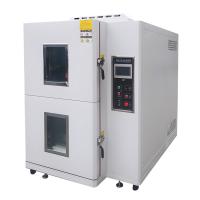
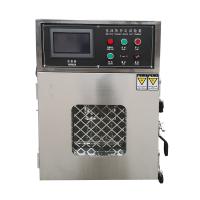
The thermal shock Test Chamber is to test the ability of the product to withstand extremely high temperature environment and extremely low temperature environment, and obtain the chemical change or physical change caused by the thermal expansion and contraction of the test sample in a short time.
In order to meet the different needs of the market, thermal shock Test Chambers can be divided into the following three types according to the temperature shock method.
1. Hatch type gaseous thermal shock Test Chamber
The "Incubator" is also a high temperature room and a low temperature room. It mainly uses the motor to trigger the movement of the basket, put the product into the basket and then transfer it, so as to achieve the purpose of high-low temperature conversion, which is a dynamic product. This style of chamber temperature shock transition time can be completed in as little as 15 seconds, with a recovery time of less than 5 minutes.
Hatchback units don't require additional exhaust time. It uses a motor to drive the basket to move up and down. However, it's kind of bad because this mechanical movement is prone to wear and tear, and the equipment is checked regularly. Thermal shock chambers require more time and money to maintain.
2. Hatchback liquid thermal shock Test Chamber
Inject the silicone oil into the high temperature chamber and the low temperature chamber, put the tested product into the basket, and then move the basket continuously between the high temperature chamber and the low temperature chamber, so as to achieve the purpose of drastic temperature change. Unlike the aforementioned hatchback Test Chamber, this thermal shock Test Chamber has a faster temperature transition rate.
3. Three-chamber thermal shock Test Chamber
That is, the Test Chamber with high temperature chamber, low temperature chamber and normal temperature chamber is a static product. The product under test will be tested while it is in the normal room. It only needs to start and close the dampers in the high temperature room and the normal room, and the dampers in the low temperature room and the normal room, which will cause the shock effect of high temperature and low temperature. Because the test equipment needs exhaust time, the temperature in the test tank can quickly become normal temperature, which is convenient for taking and placing test samples.
In addition, since the product under test does not require a motor to drive the product to move, this static testing method not only saves energy, but also reduces wear and tear on equipment components. This type of thermal shock Test Chamber is in a relatively stable state during the test, and the temperature shock transition can be completed within 3 seconds, and the recovery time is the same as that of a hatchback, within 5 minutes.