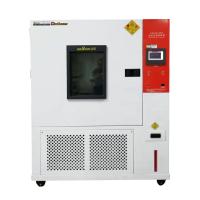
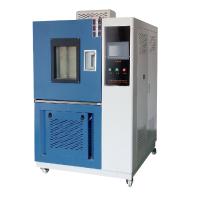
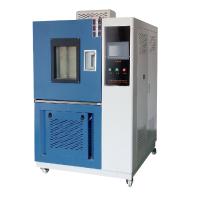
1. The first reason why the high-low Temperature Test Chamber is not refrigerated:
1. Since the temperature of the high-low Temperature Test Chamber cannot be maintained, observe whether the refrigeration compressor can be started during the operation of the Test Chamber, and whether the compressor can be started during the operation of the environmental test equipment. This means that the circuit from the mains to each compressor is normal and there is nothing wrong with the electrical system.
2. If there is no problem with the electrical system, continue to check the refrigeration system. First, check whether the exhaust and suction pressures of the low-temperature (R23) compressors of the two sets of refrigeration units are lower than the normal value, and the suction pressure is in a vacuum state, indicating that the amount of refrigerant in the main refrigeration unit is insufficient.
3. Touch the exhaust and suction pipelines of the R23 compressor of the main unit by hand, and find that the temperature of the exhaust pipeline is not high, and the temperature of the suction pipeline is not low (not frosted). This also explains the lack of R23 refrigerant in the main engine block.
2. The second reason why the high-low Temperature Test Chamber is not refrigerated:
1. The cause of the failure has not been determined, and the cause of the failure is further confirmed in combination with the control process of the Test Chamber. The Test Chamber has two refrigeration units.
2. One is the main unit and the other is the auxiliary unit. When the cooling rate is large, the two sets of units work at the same time. In the early stage of temperature maintenance, the two sets of units are still working at the same time. When the temperature starts to stabilize, the auxiliary unit stops working, and the main unit keeps the temperature stable.
If the R23 of the host leaks, the cooling effect of the host will be small. Since the two units work at the same time during the cooling process, there is no phenomenon that the temperature cannot be stabilized, but the cooling speed is only reduced.
In the temperature maintenance stage, once the auxiliary unit stops working and the main engine has no cooling effect, the air in the high-low Temperature Test Chamber will rise slowly. When the temperature rises to a certain level, the control system will activate the auxiliary unit to cool down and lower the temperature. Approaching the set point (-55 ℃), then the auxiliary unit stops working again, and so on.
So far, it has been confirmed that the cause of the production failure is the leakage of refrigerant R23 of the low-temperature (R23) unit of the main engine. Check the refrigeration system for leaks with a combination of a leak Detector and soapy water. It was found that the valve stem of the hot gas bypass solenoid valve was cracked, and the slit was about 1cm. Replaced the solenoid valve, charged the system with fluorine, and the system worked fine.

It can be seen from the above that the analysis and judgment of the fault phenomenon is basically carried out in the order from easy to difficult, from outside to inside, first power on and then cool down. Familiarity with and understanding of the working principle and process of the high-low Temperature Test Chamber is the basis for analyzing and judging faults.