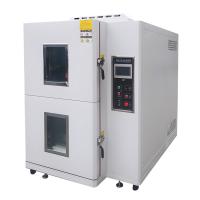
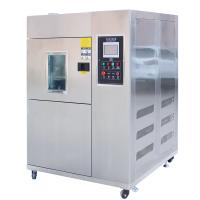
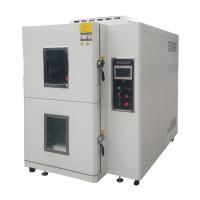
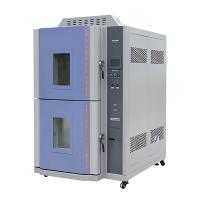
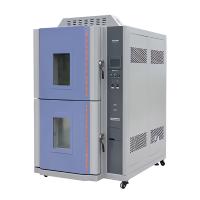
1. The air-cooling method of the double-chamber thermal shock Test Chamber
Multi-stage diaphragm air heat exchanger
2. Air circulation device of double-chamber thermal shock Test Chamber:
The double-chamber cold and heat shock Test Chamber has built-in air-conditioning room, circulating air duct and long-axis centrifugal fan. It uses a high-quality refrigerator and an energy conditioning system to effectively exchange air through high-quality fans to achieve temperature changes.
The temperature uniformity of the thermal shock Test Chamber is greatly improved by improving the air flow, air flow and heat exchange ability with the heater and air surface cooler.
3. Double-chamber thermal shock Test Chamber for refrigeration system and compressor:
In order to ensure the cooling rate and temperature requirements of the Test Chamber, the Test Chamber adopts a binary cascaded water-cooled refrigeration system composed of semi-hermetic compressors imported from Germany Bitzer. It includes high temperature refrigeration cycle and low temperature refrigeration cycle. The connecting vessel is an evaporative condenser. The evaporative condenser also plays the role of energy transfer, and the heat energy in the working room is transferred through the two-stage refrigeration system to achieve the purpose of cooling.
The refrigeration system is designed using energy regulation technology. An effective treatment method can not only ensure the normal operation of the refrigeration unit, but also effectively adjust the energy consumption and cooling capacity of the refrigeration system, so that the operation of the refrigeration system can be effectively adjusted, and the cost and failure rate can be reduced to a more economical state.
4. The working principle of the double-chamber thermal shock Test Chamber:
Both high-low temperature refrigeration cycles adopt reverse Carnot cycle, which consists of two isothermal processes and two adiabatic processes.
The process is as follows: the refrigerant is adiabatically compressed to a higher pressure by the compressor, which consumes the work of increasing the discharge temperature, and then the refrigerant exchanges heat isothermally with the surrounding medium through the condenser, and transfers the heat to the surrounding medium. After the refrigerant undergoes adiabatic expansion through the stop valve, the temperature of the refrigerant will decrease.
The refrigerant isothermally absorbs the heat from the higher temperature object through the evaporator, so that the temperature of the cooled object is lowered. This cycle is repeated for high-low temperature impact testing purposes.