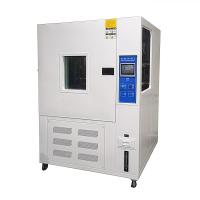
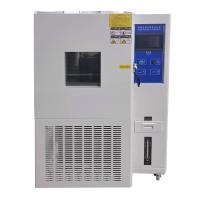
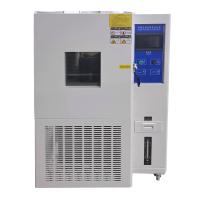
The constant temperature and humidity Test Chamber supports its work through six systems including refrigeration system, heating system and control system. Constant temperature and humidity Test Chamber test equipment has climate functions such as simulating high-low temperature, natural environment temperature and humidity. Therefore, the normal operation of the six major systems is indispensable.
Constant temperature and Humidity Chamber control system
The control system is the core of the comprehensive Test Chamber, which determines important indicators such as the heating rate and accuracy of the Test Chamber.
At present, most controllers in constant temperature and Humidity Chambers use PID control, and a few use the combination of PID and fuzzy control. Because the control system basically belongs to the category of software, and this part generally has no problems during use.
Humidity system of constant temperature and Humidity Chamber
The temperature system is divided into two subsystems, humidification and dehumidification.
The humidification method generally adopts the steam humidification method, that is, the low-pressure steam is directly injected into the test space for humidification. This humidification method has high humidification capacity, fast speed, sensitive humidification control, and is easy to realize forced humidification, especially when the temperature is lowered.
There are two methods of dehumidification: mechanical refrigeration dehumidification and dry dehumidification. The dehumidification principle of mechanical refrigeration dehumidification is to cool the air below the dew point temperature, so that the water vapor greater than the saturated water content condenses and precipitates, thereby reducing the humidity. The dehumidification of the dryer is to use the air pump to extract the air in the Test Chamber and inject dry air. At the same time, the humid air is sent to the recyclable dryer for drying, and after drying, it is sent to the Test Chamber, and the dehumidification is repeated in this cycle.
At present, most comprehensive Test Chambers use the former dehumidification method and the latter dehumidification method, which can make the dew point temperature lower than 0°C. It is suitable for occasions with special requirements, but the cost is more expensive.
Constant temperature and humidity room refrigeration system
The refrigeration system is one of the key components of the comprehensive Test Chamber. Generally speaking, the refrigeration methods include mechanical refrigeration and auxiliary liquid nitrogen refrigeration. Mechanical refrigeration adopts vapor compression refrigeration, which is mainly composed of compressor, condenser, throttling mechanism and evaporator.
If the low temperature we tested reaches -55°C, it will be difficult to meet the requirements of stand-alone refrigeration. Therefore, the refrigeration method of the constant temperature and Humidity Chamber generally adopts cascade refrigeration.
The refrigeration system of the constant temperature and Humidity Chamber consists of two parts, a high temperature part and a low temperature part, and each part is a relatively independent refrigeration system. The evaporation of the high-temperature part of the refrigerant absorbs the heat of the low-temperature part of the refrigerant and evaporates; the evaporation of the low-temperature part of the refrigerant absorbs the heat of the object to be cooled (air in the test room) to obtain cooling capacity.
The high-temperature part and the low-temperature part are connected by an evaporative condenser, and the evaporative condenser is both a condenser for the high-temperature part and a condenser for the low-temperature part.
Constant temperature and Humidity Chamber heating system
Compared with the cooling system, the heating system of the Test Chamber is relatively simple. It is mainly composed of high-power resistance wires. Due to the high heating rate required by the Test Chamber, the heating system power of the Test Chamber is relatively large, and the bottom plate of the Test Chamber is also equipped with a heater.
Constant temperature and Humidity Chamber sensor system
The sensors are mainly temperature and humidity sensors. Commonly used temperature sensors are platinum resistance thermometers and thermocouples.
There are two methods of humidity measurement: wet and dry bulb thermometer method and solid-state electronic sensor direct measurement method. Due to the low measurement accuracy of the dry-wet bulb method, the current constant temperature and Humidity Chambers are gradually using solid-state sensors instead of dry-wet bulbs to measure humidity.
Constant temperature and humidity room supply air circulation system
An air circulation system usually consists of a centrifugal fan and a motor that drives it. It provides air circulation in the Test Chamber.