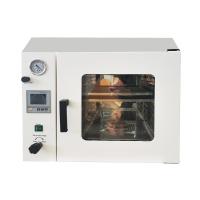
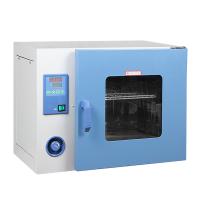
Different problems will arise during the use of vacuum Drying Ovens. Below are several common problems and their solutions.
1. The reason why there is no temperature uniformity parameter in the electric heating vacuum oven
Generally, the electric heating Drying Oven is equipped with temperature uniformity parameters: the natural convection Drying Oven is the upper limit of the working temperature multiplied by 3%. Forced convection ovens are the operating temperature multiplied by 2.5% of the upper limit. Why is there no temperature uniformity parameter set for only the electric heating vacuum Drying Oven?
It is almost impossible for the temperature of the working chamber to reach a uniform temperature depending on the movement of gas molecules in the vacuum Drying Oven. Therefore, from a conceptual point of view, we can no longer apply the definition of temperature uniformity specified by the usual electric heating (blast) Drying Oven to the vacuum Drying Oven, and it is meaningless to set this indicator as a vacuum state. The amount of heat radiation is inversely proportional to the square of the distance. The same object is 1/4 of 10cm away from the heating wall. The difference is huge.
This phenomenon is the same as when basking in the sun in winter. The side exposed to the sun is warm, while the side not exposed to the sun is relatively cold. Because of the structure of industrial vacuum ovens, it is difficult to achieve points in the three-dimensional space of the studio. The uniformity and consistency of spherical radiant heat and the lack of evaluation methods may be the reason why there is no temperature uniformity parameter set in the standard of electric heating vacuum Drying Oven.
Second, the reason why the readings of the electric heating vacuum oven are different from the readings of the glass rod thermometer in the vacuum chamber
Generally speaking, the electric heating vacuum Drying Oven adopts the method of heating the wall of the vacuum chamber first, and then radiating the wall facing the workpiece. In this heating method, the temperature sensor of the temperature control instrument can be set on the outer wall of the vacuum, and the sensor can also accept convection, conduction and radiation heat. The glass rod thermometer in the vacuum chamber accepts radiant heat intelligently, and because the blackness of the glass rod cannot reach 1, a considerable part of the radiant heat is refracted, so the temperature value reflected by the glass rod thermometer needs to be lower than the temperature reading of the instrument. Generally speaking, it is normal for the difference between the temperature reading of the meter at 200 degrees and the reading of the glass rod thermometer to be within 30 degrees.
If the temperature sensor of the temperature control instrument is placed in the vacuum chamber by the environmental chamber supplier, the difference between the temperature value of the glass rod thermometer and the temperature reading of the instrument can be reduced. But it is impossible to eliminate, and the sealing reliability of the vacuum chamber adds a potential unreliable link. If you don't want to see this difference from a practical point of view, you can use the unique display correction function of the temperature controller to solve it.