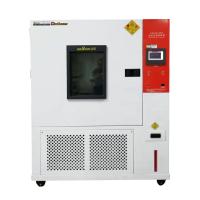
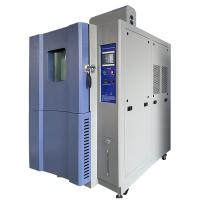
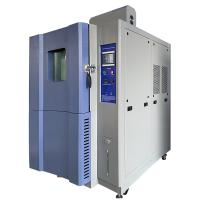
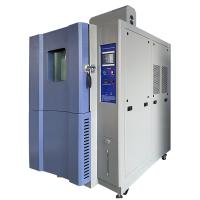
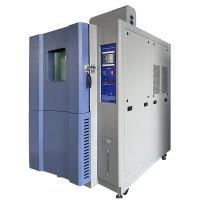
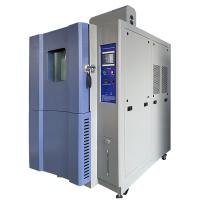
1. The main points of choosing a high-low Temperature Test Chamber
1. Regardless of whether the user chooses a high-low Temperature Test Chamber or other test equipment, it should meet the temperature conditions specified in the test requirements.
2. In order to ensure the temperature uniformity in the test area of the high-low Temperature Test Chamber, it is possible to choose whether to use forced air circulation or non-forced air circulation according to the heat dissipation of the sample.
3. The heating or cooling system of the high-low Temperature Test Chamber has no effect on the sample.
4. The high-low Temperature Test Chamber should be convenient for placing samples in relevant sample racks, and the sample racks will not change their mechanical properties due to changes in high-low temperature.
5. The high-low Temperature Test Chamber should have protective measures. For example, there are observation windows and lighting, power failure, overheating protection, and various alarm devices.
6. According to customer requirements, check whether the constant temperature and Humidity Chamber has remote monitoring function.
7. When the high-low Temperature Test Chamber is used for cyclic tests, it is required to install automatic counters, indicator lights, recording equipment, and automatic shutdown instrumentation devices, and it is required to have good recording and display functions.
8. According to the sample temperature of the high-low Temperature Test Chamber, there are two measurement methods: upwind and downwind sensor temperature. The position and control method of the temperature and humidity control sensor in the high-low Temperature Test Chamber can be selected, and the appropriate equipment can be selected according to the customer's product testing requirements.
2. Classification of high-low Temperature Test Chamber refrigerators
The refrigerator is the core equipment of refrigeration. By converting electrical energy into mechanical work, the low-temperature and low-pressure gaseous refrigerant is compressed into high-temperature and high-pressure gas, thereby ensuring the refrigeration cycle. What are the classifications of refrigerators?
1. Centrifugal refrigerator
It relies on centrifugal force to continuously compress the inhaled gas, with a cooling capacity of up to 30,000 KW. It is used in large central air conditioners and large storage refrigeration equipment. It has stable work, high performance, long life, large cooling capacity, and can be adjusted steplessly, this kind of high-low Temperature Test Chamber is rarely used in the environmental test industry of refrigerators, and requires a professional Test Chamber manufacturer.
2. Volumetric refrigerator
This is relatively familiar. Its working principle is to compress the periodic intake of quantitative gas by changing the volume of the working chamber. Reciprocating piston refrigeration compressor: the working volume of the cylinder is changed by the reciprocating motion of the piston. According to the external structure, it is divided into two types, including fully enclosed and semi-enclosed.
Fully enclosed: cooling capacity less than 60kw, used for air conditioners and small refrigeration equipment. The driving motor and moving parts are enclosed in the same space, with compact structure, good sealing and low noise. But the power is small, not easy to repair;
Semi-closed type: the cooling capacity is 60~600KW, which can be used in various air conditioning and refrigeration equipment. A closed space is formed by the crankcase body and the motor housing. Stable operation and long service life. Large cooling capacity, can be used under various conditions. Also, it's easy to fix and slightly more noisy. This type can be divided into single-stage compression type, such as conventional type, butterfly valve type, unloading type, connection type and two-stage compression type.