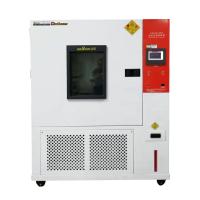
Accurate temperature and humidity control in environmental chambers is a complex issue. Understanding the nuances of humidity control requires an understanding of the importance of precise temperature control and what "relative" means in relative humidity readings.
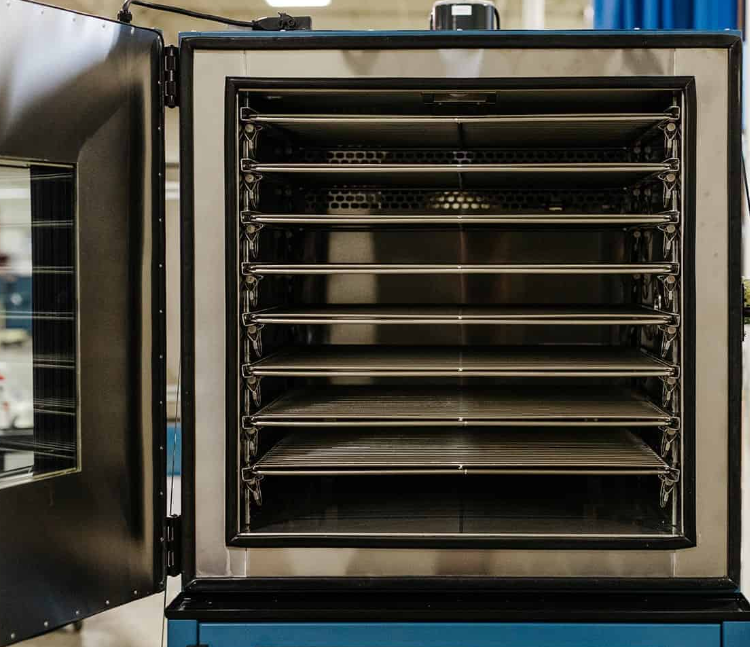
A good example of the importance of temperature control in relative humidity calculations is found in ASHRAE 1993: At 23°C and 50%RH, at a constant humidity content [true humidity measurement] of 12°C dew point, + Short-term temperature fluctuations of 1°C caused relative humidity readings to fluctuate between 47% and 53%. Even though the true moisture content in the chamber has not changed.
This is the result of calculating relative humidity from the measured water content of the air relative to the water holding capacity of the air at any given temperature (called the dry bulb temperature).
The warmer the air, the more moisture it can hold in the same volume of space, so generally, as the temperature rises, more water vapor is required to raise the relative humidity of the air. The opposite is true when the air is cold. Due to this fact, a relative humidity of 50% at a dry bulb temperature of 85°C is exponentially higher than a humidity level of 50% higher at a dry bulb temperature of 10°C.
At lower temperatures, relative humidity measurement readings are affected by changes in total moisture content of only a few grains per pound of air, while at significantly higher temperatures, it may take grams of moisture to change relative humidity readings.
Stability is the key to humidity control
Therefore, the key to precise humidity control in an environmental chamber is stability. After stabilization, typical environmental chamber control tolerances are +1°C and +5% relative humidity. Stability is defined in the industry as the point at which the chamber interior surfaces and the unit under test (UUT) will change temperature by less than 2°C per hour, and there is no change in external or internal loads (i.e. changes in door openings or thermal loads on the UUT) .
Environmental chamber control presents challenges when constant or intermittent changes in temperature and/or humidity cause instability in the environmental test profile. These are often called cyclic curves, which consist of an infinitely variable combination of "ramp" and "soak" steps in a specific sequence.
Ramp steps can simultaneously change temperature, humidity, or both up or down at a linear rate over a set period of time. The soak step maintains a constant temperature and humidity setpoint for a set period of time. Chamber heating, cooling, humidification, and dehumidification systems work in tandem in complex cycle profiles, essentially chasing elusive ever-changing set points.
It is during cyclic profiling that maintaining typical stability tolerances is nearly impossible due to the deliberate introduction of instabilities. Setpoint changes over short ranges and/or time periods produce less instability than broad changes over shorter periods of time, further compromising the chamber's ability to precisely control changing variables. This often results in short-term oscillations in temperature and/or humidity beyond the limits of the stability control tolerance.
Additional Considerations for Precise Humidity Control
Temperature and humidity control may be further disturbed when the chamber mechanical system is changed from one state to another. For example, a ramp step might require a chamber operating at high temperature/low humidity to simultaneously change to low temperature/high humidity over a period of "x" minutes.
Contrary to what one might think, the "cooling" and "humidification" systems may not need to be running initially, but instead the chamber control system simply reduces heating and dehumidification output, allowing the chamber to undergo a controlled drift that follows temperature and humidity Move set point.
At some point during this ramp step, however, reducing heating and/or dehumidification fails to provide the response needed to chase the set point, and the controller cools and humidifies the chamber by calling for small but steady increases in cooling and humidification output The system provides energy. Short-term oscillations in temperature or humidity control are also common during these transitions.
There may also be cases where periodic profiles have ramp requirements that exceed the chamber capacity used, but these requirements are usually related to chamber capacity rather than control.
Chamber capacity depends on desired profile
In conclusion, short-term oscillations beyond normal stability control tolerances are common and expected in periodic profiles. The extent, ramp rate, and complexity of the periodic profile need to be considered.
Except in rare cases, these short-term oscillations have no negative impact on the quality or legality of the entire test sequence, provided the final setpoint conditions of temperature and humidity are fully achieved and do not exceed the capabilities of the chamber used.