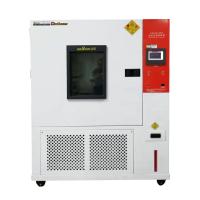
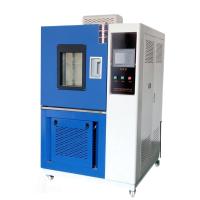
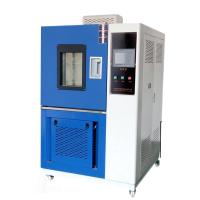
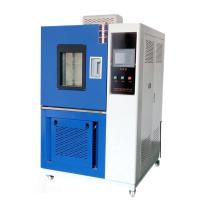
As we all know, large-volume high-low temperature test boxes can accommodate more test products, while small-volume test boxes can accommodate less and less test products. Should we keep both racks fully packed while we test the product? This is not correct. According to this standard, the volume of the working chamber of the high-low Temperature Test Chamber should be at least 3 to 5 times the volume of the test product. The reasons are as follows:
1. The accuracy indicators of the environmental parameters in the working room of the high-low Temperature Test Chamber are the test results under no-load conditions. As long as the product under test is placed, it will affect the uniformity of the environmental parameters in the working room of the high-low Temperature Test Chamber. The larger the space occupied by the product under test, the greater the influence on the environmental parameters. The measured data show that the temperature difference between the windward side and the leeward side of the flow field can reach 3-8 °C, and in severe cases, the temperature difference can reach more than 10 °C.
2. After the product to be tested is placed in the box, its channel is unblocked. The narrowing of the channel will increase the velocity of the airflow and accelerate the heat exchange between the airflow and the test product. This is inconsistent with the reproduction of environmental conditions, because the relevant standards stipulate that the airflow around the sample should not exceed 1.7m/s at the temperature of the high-low Temperature Test Chamber and the environmental test, so as to prevent the sample and the surrounding environment from being consistent with the actual heat conduction. The average wind speed when the test box is empty is 0.6-0.8m/s, not exceeding 1m/s. When the specified space and area ratio are within the above requirements, the wind speed of the flow field can be increased by (50~100)%, and the average maximum wind speed is (1~1.7) m/s, which meets the standard requirements. If the volume or windward cross-sectional area of the test product increases without limit during the test, the airflow velocity during the actual test will exceed the maximum wind velocity specified in the test standard. Therefore, the validity of the test results will be questioned.
3. According to the principle of heat conduction, the temperature of the airflow near the box wall usually differs from the temperature at the center of the flow field by 2 to 3 ℃, and the maximum can reach 5 ℃. The difference between the box wall temperature and the flow field temperature near the box wall is 2~3 ℃ (depending on the structure and material of the box wall). The greater the difference between the test temperature and the ambient temperature of the outside atmosphere, the greater the above-mentioned temperature difference. Therefore, the space within a distance of 100-150 mm from the box wall cannot be used.