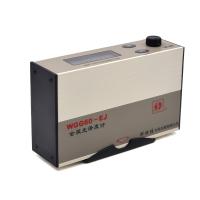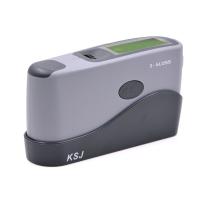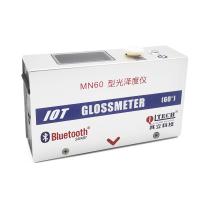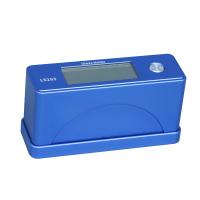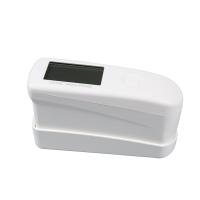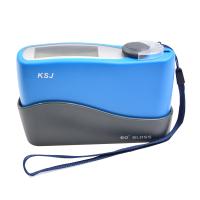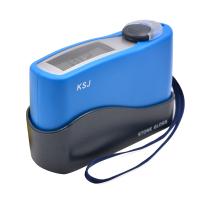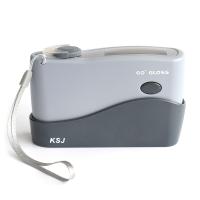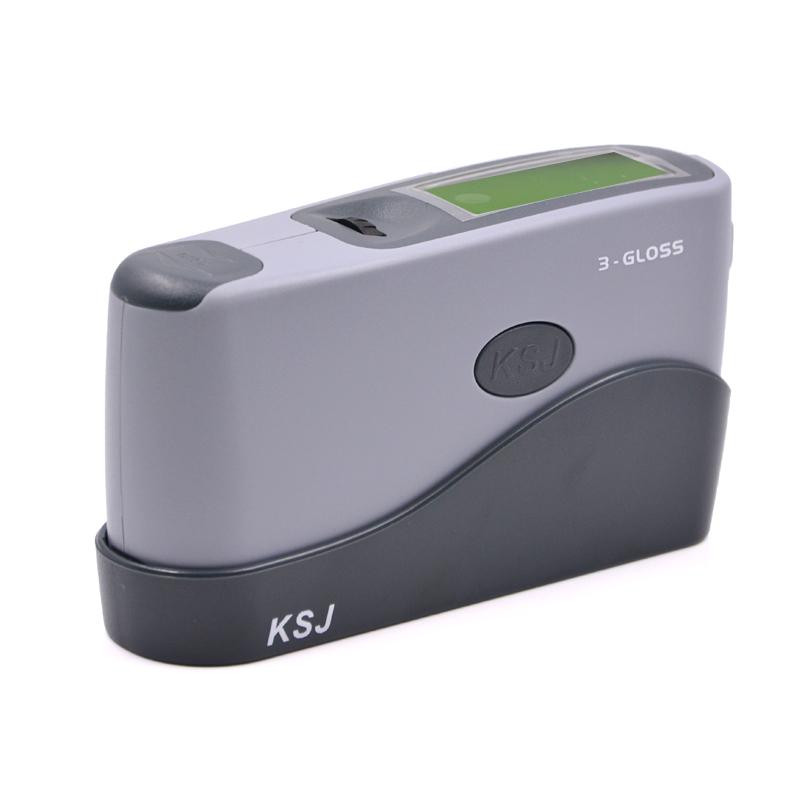
In many products, gloss is a determining factor in passing quality control and possibly even rejecting it. For this reason, the industry has gloss measurement equipment adapted to different regulations.
As a result, they need a gloss meter that can objectively and quantitatively evaluate gloss.
What is a Gloss Meter?
Gloss meters are portable devices that evaluate gloss by measuring light in the direction of specular reflection.
The device measures gloss at 20º, 60º and 85º as directed by different regulations and provides the values in Gloss Units (GU). Glossmeters relate the visual perception of gloss to gloss units. Specifically, of the three angles mentioned above, the geometric or 60-degree angle is commonly used, but the 85-degree angle is also used to measure gloss for matte materials, and the 20-degree angle for glossy materials.
Also, the 75º Geometric Glossmeter is recommended for paper and graphic arts. This instrument is used to measure the gloss of paper, cardboard and vinyl. The UNE-EN ISO 8254-1:2009 standard collects working methods for measuring the specular gloss of paper and board.
Gloss meters come with a reference gloss standard, usually polished black glass, that is used as a reference for the unit when it is in operation and subsequently used to adjust the unit's measurements.
This type of equipment is commonly used in various companies such as those involved in the manufacture of different materials such as paints, varnishes, plastics or automobiles.
The use of gloss meters in the production and processing of products in these industries makes it easier for companies to perform objective and quantitative gloss evaluations.
What is gloss?
Gloss is the visual effect or perception of a surface when light hits and reflects in a certain way.
Gloss measurement is a method of evaluating the appearance of a product, surface or material.
So talking about gloss also means talking about the reflection of light. Specifically, when light hits a surface, there are two types of reflections called diffuse and specular.
These two types of reflection have different properties, so, in diffuse reflection, light rays are reflected in different directions, while in specular reflection, light rays are reflected in the same direction or in the same direction at the same angle of incidence. The latter type of reflection is responsible for the glossy effect.
On materials that have a rough rather than a smooth surface or finish, the amount of diffuse light is greater compared to the amount of direct or specular light, so the surface has a matte finish or low gloss or semi-gloss.
The opposite phenomenon occurs in materials with polished and smooth surfaces or finishes, i.e. in this type of surface light is reflected directly at the same angle of incidence or, in the same case, a greater proportion of direct light is reflected at high Diffuses light on glossy surfaces or finishes.
Technical scope of gloss meter calibration
20º, 60º and 85º geometries
Gloss meters require regular calibration to ensure measurement quality and traceability to internationally recognized reference standards.
Calibration frequency needs to be determined by the user based on usage and calibration history.
For this purpose, three Glossmeter geometries can be calibrated, namely: 20º, 60º and 85º.