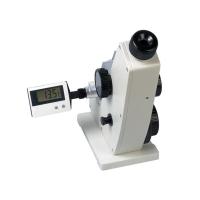
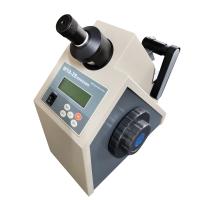
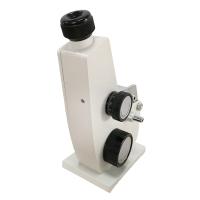
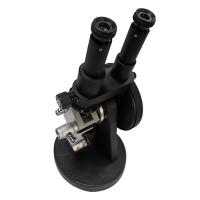
A refractometer measures the refractive index of a material medium based on the physical principle of light refraction. These devices are used in different fields where it is necessary to control the refractive index of the materials they are used in. Some of these industrial sectors that use refractometers in their laboratories are the cosmetics industry or manufacturers of detergents, enamels, paints and varnishes, etc.
Refractometers usually provide a value in degrees Brix in addition to measuring the refractive index. This unit type determines the amount of sugar in a substance and as such, it is a commonly used scale in the agri-food industry. It is therefore not uncommon to find information on Brix levels in products such as honey, tomato preserves or jams. Another sector that uses the Brix measurement is enology, as this unit of measurement is also used to determine the alcohol contained in grape juice.
There are different types of refractometers, with different resolutions, scales and ranges.
Manual refractometer
The use of a manual refractometer requires a properly trained laboratory technician, as in this type of refractometer, the measurement is made by the technician's direct observation, so the technician's preparation is a necessary factor that does not affect the accuracy of the results .
Digital Refractometer
These devices consist of light sources, prisms and optical sensors. With these refractometers, measurements are done digitally, so the technician's influence is much less than when using a manual refractometer.
temperature
Temperature is a very important variable in the measurement of Refractive Index and Brix. Any change in temperature will affect the values obtained in the measurement.
Refractometer readings are required to be taken at 20℃ by regulation. Since it is not always easy to maintain a stable temperature in a production environment or in the laboratory itself, it is necessary to correct the measured values for the ambient temperature. These modifiers or factors are listed in the table.
For this reason, many refractometers incorporate a temperature compensation system: ATC. These devices have a system for measuring the temperature of the sample to be tested and provide a value that is compensated on a 20℃ basis.
Technical scope of refractometer calibration