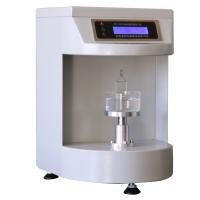
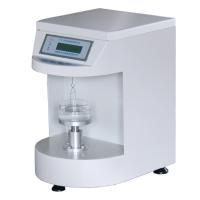
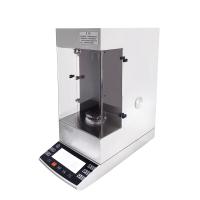
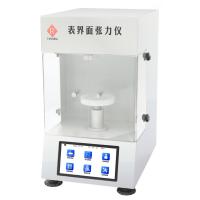
principle
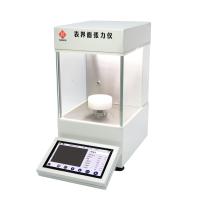
When measuring the interfacial tension, the platinum ring is immersed in a certain position in the liquid to be measured, and the glassware containing the liquid is driven down by the motor, precision screw, and sample stage.
When the platinum ring reaches the position of the liquid interface, the tension of the interface will pull the platinum ring to generate a downward pulling force and form a liquid film between the platinum ring and the measured liquid.
This pulling force twists the torsion wire through the lever arm and moves the sensor core upward. The sensor measures the displacement generated by the magnetic core and converts it into a corresponding pulling force value. The maximum force value during the process of the liquid film being pulled up until it ruptures is regarded as the interfacial tension value.
When using the platinum ring method for testing, a small amount of liquid will stick to the platinum ring. It will have a certain influence on the actual interfacial tension value, so the tension correction coefficient is introduced to correct the actual force value to obtain the surface tension value of the liquid.
That is, the actual interfacial tension is obtained according to the following formula: V=P*F
V: the interfacial tension value of the measured ring;
P: The measured force value when using the platinum ring method;
F: correction factor
The correction factor F depends on the measured tension value P, the liquid density, the radius of the platinum wire and the radius of the platinum ring. This is the measurement principle of the complete interface Zhang Liyi, do you understand? If you have any questions, please consult the North and South Tide technical engineers.