Reader's Guide
This manual is compiled based on manufacturer's data. Due to equipment batch changes, the content may not fully match every physical unit. Please refer to the actual operation and on-device labels.
Copyright belongs to the manufacturer. For internal reference of purchasers only. If safety parameters in the manual differ from the physical unit, please suspend operation and consult our engineer for confirmation.
Disclaimer: This manual is for reference only. In case of any discrepancy, the physical unit shall prevail. Our company assumes no liability for any consequences arising from operations based on this manual.
CCYONGXIN ZQX-1000 paper Air Permeability Tester Instruction Manual
Product user manual
Table of Contents
I. Production Basis ...... 3
2. Uses and Scope of Application ...... 3
3. Main Technical Parameters and Working Conditions ...... 3
4. Structure and Working Principle ...... 4
5. Test Steps ...... 5
VI. Installation and Adjustment ...... 7
7. Maintenance and Care ...... 7
1. Production basis
The Schauberg method paper permeability tester is based on the industry standards of the People's Republic of China QB/T1667 "Paper Permeability (Chaubel Method) Tester" And the design and manufacturing
2. Purpose and Scope of Application
Many types of paper, such as cement bag paper, paper bag paper, cable paper, copy paper, and industrial filter paper, all require measuring their breathability. This instrument is specifically designed and manufactured for these types of papers. This instrument is suitable for air permeability when 1×10 -2 ~ 1×10 2 μm/(Pa·s) Paper between these is not suitable for paper with a large surface roughness.
3. Main technical parameters and working conditions
1. Measurement range: 0—1000 mL/min
2. Test area: 10 ± 0.02 cm 2
3. Test zone pressure difference: 1 ± 0.01 kPa
4. Measurement accuracy: less than 100 mL, volume error of 1 mL; For values greater than 100 mL, the volume error is 5 mL.
5. Inner diameter of the clamping ring: 35.68 ± 0.05 mm
6. The coaxiality of the center holes of the upper and lower clamping rings is less than 0.05 mm
The instrument should be placed on a sturdy and stable workbench in a clean environment with room temperature of 20±10 °C.
4. Structure and Working Principle
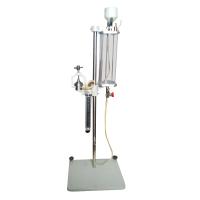
The instrument consists of a container (12) on the fixed support (2), a paper sample clamp ring (4), and a pressure gauge (6). The upper part of the container is equipped with a vent valve (13) and a water filling valve (1) with a funnel, and distilled water is injected into the container through a water filling valve with a funnel. The bottom of the container is equipped with an overflow valve (11) and a regulating valve (10) to control the flow of water. The paper pattern clamping ring and similar components are fixed to the bracket (3), and the paper sample clamping ring and the air box (5) have a hole with an area of 10 cm². The air box is located below the paper sample clamp ring, with two connectors connected to the exhaust pipe and pressure gauge by rubber hoses. The base (9) below the instrument forms the foundation of the entire instrument, with a level (7) installed on it. Two adjustment bolts (8) are rotated to adjust the instrument's horizontal position.
The working principle of this instrument is: under specified conditions, under unit time and unit pressure difference, the average airflow per unit area of paper page.
5. Test Procedures
Close the overflow valve and control valve, open the water filling valve and vent valve, fill the container with distilled water from the funnel filler valve, close the water filling valve and vent valve, clamp the sample tightly between the paper sample clamp ring and the air box, place a graduated cylinder below the overflow outlet, open the overflow valve, and rotate the control valve to adjust the pressure difference in the test zone to 1 kPa (100 mm water column). If this cannot be achieved, loosen the locking bolt to lift the overflow pipe until the pressure difference in the test area reaches 1 kPa. Once stabilized, Start the stopwatch to extract the amount of water in the graduated cylinder in 1 minute, or the time required to fill 100 mL of water in the cylinder.
Since the permeability of paper is proportionally proportional to the constant pressure difference and measurement time, other pressure difference and measurement times can be selected if necessary, but must be indicated in the report.
Before testing, refer to Table 1 to select the appropriate test duration required to measure air permeability. When selecting different test durations, the reading error of the test results should not exceed 2.5%.
| Airflow rate in ml/second | Test duration: s | Measure the volume in ml |
|---|---|---|
| 0.13—0.33 | 300 | 40—100 |
| 0.33—0.83 | 120 | 40—100 |
| 0.83—1.67 | 60 | 50—100 |
| 1.67—5.0 | 120 | 200—600 |
| 5.0—10.0 | 60 | 300—600 |
| 10.0—20.0 | 30 | 300—600 |
| 20.0—40.0 | 15 | 300—600 |
6. Installation and Adjustment
1. Place the instrument on a stable, vibration-free workbench and adjust the instrument level.
2. Test the system sealing
The permeability testing system consists of a specimen clamping mechanism, U-shaped pressure gauge, water receiver glass cylinder, valve, and connecting fittings. The system's sealing should meet the following requirements: a smooth metal round plate is placed between the upper and lower clamping rings, then the upper clamping ring is pressed tightly, adjusting the pressure difference between the system inside and outside to 1 kPa to seal all valves. After 30 minutes of inactivity, the pressure drop indicated on the pressure gauge should not exceed 0.01 kPa (i.e., one small division of the scale scale on the gauge).
7. Maintenance and servicing
Operators should thoroughly read the user manual and strictly follow the operating procedures. Non-professionals are not allowed to operate.
Keep the instrument clean regularly. To prevent impurities from depositing on the glass container, distilled water should be used inside the pressure gauge and container.
All valves should be regularly replaced with vacuum grease to ensure sealing performance and smooth rotation.
- 1SMTSER NBC-120 Gravure Printing Proofer Instruction Manual
- 2SMTSER NBC-225 offset ink colorimeter instruction manual
- 3SMTSER NBC-A200 Flexographic Printing Proof instrument
- 4RONGHUA INSTRUMENT HH-S series digital display thermostatic oil bath instruction manual
- 5SHIMADZU ATX/ATY Series, Electronic Analytical Balance Instruction Manual
- 6AISRY ASR-339A Rubber alcohol Wear resistance tester instruction manual
- 7RONGHUA INSTRUMENT 78-1 Magnetic Stirrer
- 8AISRY ASR-5608 Electric Pencil hardness tester instruction manual
- 9JINGKELIAN QFS Wash Resistance Tester Instruction Manual
- 10AISRY ASR-8503 Side Press/Ring Crushing Test Machine (Button) Instruction Manual