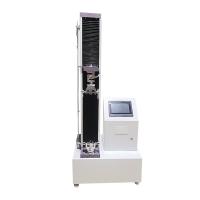
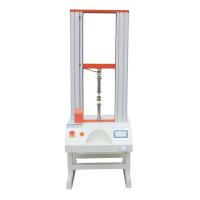
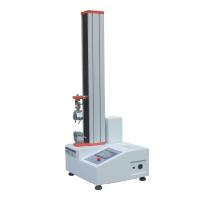
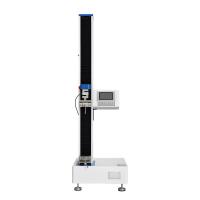
Tensile test is the core means of material mechanical property testing, widely used in metals, plastics, textiles and other industries, the accuracy of test curves and data directly determines the reliability of material performance judgment, product quality control and R&D verification. Curve fluctuation and data deviation are two common types of anomalies in the test, and this paper combines practical experience to disassemble the causes and treatment schemes in point to help improve the accuracy of the test.
1. Curve fluctuations: causes and treatment plans
Core definition
During the test, the force value and displacement curve have irregular jagged runout, sudden changes or unsmoothness, which cannot truly reflect the continuous process of material force deformation.
Main causes
equipment level - loose force value sensor, poor signal line contact or zero point drift; Insufficient lubrication and stuttering of the lead screw of the transmission system; Extensometer gripper wear and installation deviation.
Operational level - the specimen clamping is skewed and the clamping force is uneven, resulting in the force shift of the specimen; If the test speed is set unreasonably, too fast or too slow will affect data acquisition.
Environmental level - the temperature of the laboratory fluctuates too much, and there are vibration sources such as punches and air compressors around, interfering with sensor signals.
Handling measures
Standardized operation: re-clamp the specimen to ensure that the axis and the tensile direction are consistent and the clamping force is uniform; Adjust the test speed according to the standard (metal ≤ 5mm/min, non-metal reference corresponding standard).
Equipment inspection: fasten the sensor connection wire and perform zero point calibration, and verify the accuracy with standard weights; Clean and lubricate the lead screw, guide rail, and replace worn extensometer grippers.
Environmental optimization: Move the equipment to a constant temperature (23±2°C) and vibration-free area, and install anti-vibration pads to avoid sudden temperature changes and electromagnetic interference.
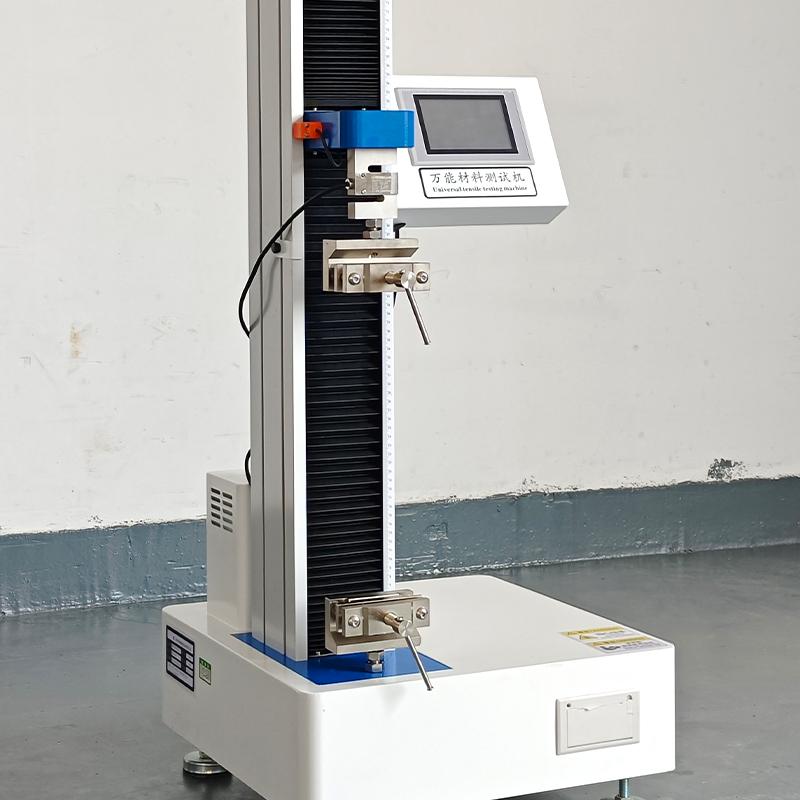
2. Data deviation: causes and treatment plans
Core definition
The mechanical property data (tensile strength, yield strength, etc.) tested by the same batch of specimens and the same equipment are too dispersive, or the deviation from the standard specimen and historical data exceeds the allowable range (5% for metals ≤and 10% ≤for non-metals).
Main causes
Equipment factors – equipment is not calibrated regularly, sensors are inaccurate, resulting in system errors.
Specimen factors - irregular specimen preparation (dimensional tolerance exceeding the standard, surface burrs), poor material uniformity, and unstable specimen state.
Operational factors - inconsistent clamping force of operators, improper timing of data reading, and human error.
Data processing - The software collection frequency is too low and the algorithm is defective, resulting in distorted data processing.
Handling measures
Equipment calibration: The force value sensor is sent to the measurement agency every 12 months, and the extensometer is sent to the measurement agency every 6 months, and the standard specimens are compared and verified on a daily basis, in line with the GB/T 16491 standard.
Specimen specification: Specimen is processed according to the national standard, dimensional tolerance is controlled, and it is placed in a stable state for 24 hours in a standard environment after preparation.
Standardized operation: Formulate SOP specifications for clamping force, test speed and data reading timing, and regularly train operators.
Data optimization: Enable the software peak maintenance and digital filtering functions, use the 3σ principle to eliminate abnormal data, and calculate parameters according to the national standard.
3. Daily operation and maintenance and precautions
Regularly clean equipment components, check the status of the transmission system and sensors, and make maintenance records.
Establish an environmental monitoring mechanism to record temperature, humidity and vibration to keep the test environment stable.
retain the original test curve and data for subsequent traceability and troubleshooting; When abnormalities occur repeatedly, check the aging of equipment components or software compatibility, and contact the manufacturer for debugging if necessary.
In summary, the core of dealing with the two types of abnormalities is to identify the cause and implement precise policies, through standardized operation, equipment calibration, environmental control and standardization of the whole process, it can effectively improve the accuracy and stability of test data, and provide reliable support for production and research and development.