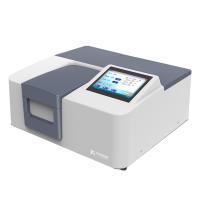
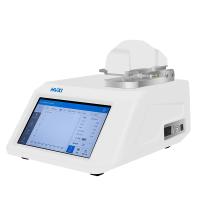
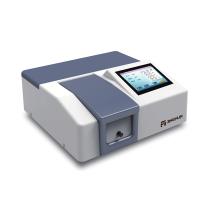
1. Classification and basic working principle of spectrophotometry
The photoelectric Colorimeter uses a filter to obtain monochromatic light, because the performance of the filter is poor, only approximate monochromatic light can be obtained, thus affecting the sensitivity and accuracy of the photoelectric Colorimeter. The use of spectrophotometry, while improving the sensitivity of the instrument. Some instruments use special photocells instead of photocells at the same time, which expands the range of spectral regions used.
Spectrophotometry is to divide the compound light into a series of monochromatic light wavelengths through a spectroscopic system (also known as a dispersion system). Among them, the monochromatic light of a certain wavelength can be determined according to the absorption intensity of a certain wavelength of light by the measured substance. Weak to choose.
The spectroscopic system of a Spectrophotometer is also called a monochromator, which usually uses an auxiliary mirror to divide the composite light into monochromatic light; the construction of other parts is basically the same as that of a photoelectric Colorimeter.
(1) classification

(2) Basic working principle
The quantitative relationship of spectrophotometry can also be expressed by Lambert-Beer's law. Spectrophotometry is more sensitive than photoelectric colorimetry, and its sensitivity can be represented by two molar absorptivity e and forbidden (SandeJ1) sensitivity S (also known as sensitivity index 9).
According to the Lambert-Beer law (Formula 7-4), it can be seen that the molar absorptivity of most color reactions is 10~105, and the larger the value, the higher the sensitivity of the color reaction.

2. Construction and use of Spectrophotometer
Taking Model 721 Spectrophotometer 0 as an example to introduce its structure and application.
The 721-type Spectrophotometer is suitable for quantitative colorimetric analysis in the range of 360-800nm in the visible spectral region. The instrument can increase the extinction film between 410~710nm or use the colored solution as the foil of the measured solution instead of the empty one, so as to improve the analysis sensitivity and increase the extinction reading range.
(1) The structure of the instrument
The instrument is composed of light source lamp parts, monochromator parts, incident light and outgoing light adjustment parts, cuvette seat parts, photocell cassette (electronic amplifier) parts, regulated power supply parts and other parts. See Figure 7-11 for its structural principle diagram, and Figure 7-12 for a schematic diagram of its internal structure.

(2) Optical system
Model 721 Spectrophotometer adopts self-collimating optical path and single-beam method. Its wavelength range is 360~800nm. It uses white tungsten filament and light bulb as light source. The schematic diagram of the optical system is shown in Figure 7-13.

The continuous radiant light emitted by the light source lamp hits the condenser lens, and after converging, it passes through the plane mirror at a 90° angle, and is reflected to the incident aperture. When the light reaches the monochromator, the narrow bell is just on the focal plane of the spherical collimator mirror. When the incident light is reflected by the collimator mirror, it will be directed to the connecting mirror with a beam of parallel light (the blue surface of the connecting mirror will be coated) , After the light enters the mirror, it will be dispersed in it. The incident angle is at the minimum deflection angle. After the objective lens is reflected, it will gather on the exit slit. The exit slit and the entrance slit are integrated. In order to reduce the influence of the curved shape of the spectral line after passing through the mirror on the monochromaticity, the two narrow knife edges are made It is in an arcuate shape, so that it approximately matches the curvature of the spectral line, ensuring that the instrument has a certain degree of monochromaticity.