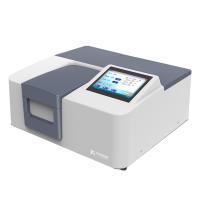
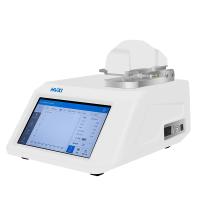
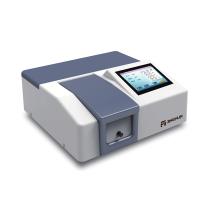
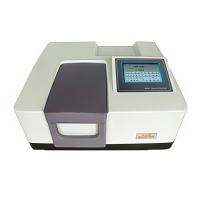
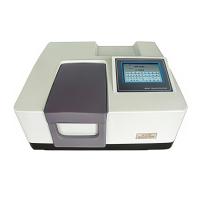
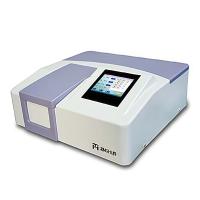
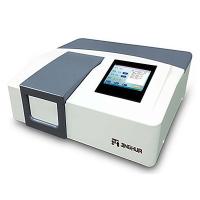
—, boot preheating
The instrument should be warmed up for 30 minutes before use.
2. Wavelength setting
1. Press the ▲ key, and observe the wavelength value on the display to reach the desired test wavelength.
2. Press the number keys to display SET WL=XXX (wavelength setting value), and then press the "Enter" key to the required test wavelength.
Note, after the wavelength setting is adjusted to 100%T/0A, it is better to test after 5 minutes of stability (in line with industry standards and the requirements of the Quality Supervision Bureau's inspection regulations).
3. Set the test mode
Press the "Test Mode" button to switch the test mode. The corresponding test mode loop is as follows:

*The default test method when starting up is the absorbance method
4. Set the concentration test function
In the concentration test mode, press the "Function" button to enter
sTD/CONC=1000 standard concentration grape test method, or
sTD/FACr=1000 slope test method.
5. Adjust T to zero (O%T)
To adjust the instrument to 0%T, the sample chamber cover must be closed. Press the "adjust 0%T" button and the display will display "ZERO...", the instrument will enter the state of automatic adjustment "0%T", and the adjustment will be completed when the display shows "XXX.X%T or -O.XXXA" T
zero.
6. Adjust 100% T/OA
Put the reference (blank) sample into the sample holder, and pull the rod of the sample holder to enter the optical path. Then press the "Adjust 100%T/0A" button, and the screen will display "BLANK..." and then display "100.0%T" (in T mode) or "-0.000A". "0.000A" ( In A mode), that is, automatically complete the adjustment of 100%T/0A.
*Precautions: Do not open the sample chamber cover, push or pull the sample rack when adjusting 100% T/OA.
7. Print the result
After the test result is obtained, press the "print" button, and the result can be sent to an external printer through RS232 to print the result.
8. Matching of cuvettes
The cuvette attached to the instrument has been paired and tested (the pairing error is not greater than 0.5%T), and the cuvette that has not been paired will affect the test accuracy of the sample. A set of two quartz cuvettes is used in the ultraviolet and visible spectrum regions, and a set of four glass cuvettes is used in the visible spectrum region. The cuvettes are directional. When placed in the sample holder, the directions marked Q or arrows on the two quartz cuvettes and G on the four glass cuvettes must be consistent.
Quartz cuvettes and glass cuvettes cannot be mixed, let alone with other unmatched cuvettes. When holding the cuvette with your hands , you should hold the frosted surface of the cuvette, and should not touch the transparent surface of the cuvette, that is, there should be no fingerprints or traces of the solution on the transparent surface, and there should be no air bubbles or suspended matter in the solution to be tested, otherwise It will also affect the test accuracy of the sample. Cuvettes should be cleaned immediately .
9. Basic Operation
(—) Absorbance test
1. Press the "Test Mode" button to switch to the absorbance test mode.
2. Adjust the test wavelength
3. Put in the reference (blank) sample, press the "adjust 100%T/0A" key, and then the instrument will display "BLANK..." and then display "-0.000A" or "0.000A" after a few seconds delay .
4. Press the "adjust 0%T" key, "ZERO..." will be displayed on the display, and the instrument will enter the state of "0%T" automatically. When the display displays "0.000A" or "-0.000A", Then complete the T zero adjustment.
5. Confirm that 0.000A is correct.
6. Insert the sample to be tested and read the test data.
(2) Transmittance test
1. Press the "Test Mode" button to switch to the transmittance test mode.
2. Adjust the test wavelength.
3. Put in the reference (blank) sample, press the "adjust 100%T/0A" button, and then the instrument will display "BLANK..." and then display "100%T" after a few seconds .
4. Press the "adjust 0%T" key, "ZERO..." will be displayed on the display, and the instrument will enter the state of automatic adjustment of "0%T". When the display displays "100.0%T", the zero adjustment of T will be completed. .
5. Confirm that 100.0%T is correct.
6. Place the sample to be tested and read the test data.
(3) Concentration test
1. Press the "Test Mode" button to switch to the transmittance test mode.
2. Adjust the test wavelength.
3. Put in the reference (blank) sample, press the "adjust 100%T/0A" key, at this time the instrument will display "BLANK..." and then display "100%T" after a few seconds delay
4. Press the "adjust 0%T" key, "ZERO..." will be displayed on the display, and the instrument will enter the state of automatic adjustment of "0%T". When the display displays "100.0%T", the zero adjustment of T will be completed. .
5. Confirm that 100.0%T is correct.
6. Place the standard concentration sample and make it enter the light path.
7. Press the "test mode" button to switch to the concentration test mode.
8. Press the "Function" key to the "STD/CONC=1000" function.
9.按动数字键,设置标准样品浓度(可输人1~5位正数含小数点),并按动“确认”键。如显示“xxx.xnm xxxxxC Conc error”表示输人标准样品浓度高。
10.置人待测样品,读取测试数据(如显示“xxx.xnm errorC”表示待测样品浓度高)。
*此为标准品对照法,即输人一个已知标准样品浓度值,建立过零线性方程,再测试一个或几个同一待测样品的浓度值。
(四)斜率方式测试
1.按动“测试模式”键,切换到透射比测试模式。
2.调整测试波长。
3.置人参比(空白)样品,按动“调100%T/0A”键,此时仪器显示“BLANK...”延迟数秒便显示“100%T”。
4.按动“调0%T”键,显示屏上显示“ZERO...”,仪器进入自动调“0%T”状态,当显示屏显示“1OO.0%T”时,便完成调T零。
5.确认100.0%T是否正确。
6.按动“测试模式”键,切换到浓度测试模式。
7.按动“功能”键至“STD/FACT=1000”功能。
8.按动数字键,设置该样品斜率(可输入1~5位正数含小数点),并按动“确认”键(如显
示Input error表示输入出错)。
9.置人待测样品,读取测试数据(如显示“xxx.xnm errorC”表示待测样品浓度高)。
*此为标准系数法,即输人待测样品的标准系数值,建立过零线性方程,再测试一个或几个待测样品的浓度值。
十、线性回归法测试(752型除外)
(1) According to the C=K*A+B unary linear regression equation, the instrument first enters the concentration calibrates the group of standard samples one by one. After the input is completed, the linear regression equation and correlation coefficient fitted by the least square method will be automatically displayed on the display . According to the linear regression equation, the concentration value of the same sample to be tested can be tested . The correlation coefficient R is used to indicate whether there is a linear correlation between C and A, and to prove whether the fitted regression equation is meaningful . When the correlation coefficient R ~ 1.000, it shows that the regression equation is more linear. The instrument allows the input of a maximum of 16 standard samples . In addition, the instrument also has functions such as storage (up to 8), recall, and deletion of linear regression equations.
1. Establish a linear regression equation
The sequence of operations is as follows: