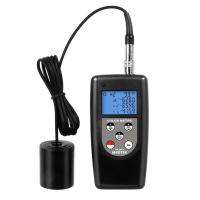
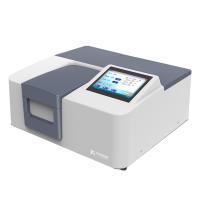
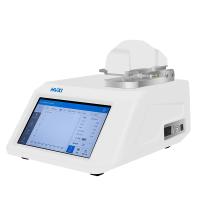
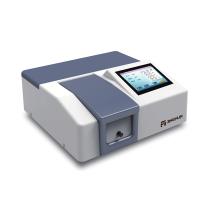
A Colorimeter is a light-sensitive instrument used to measure the emission and absorption of light by a liquid sample. This instrument measures the intensity or concentration of the color formed when a specific reagent is introduced into a solution.
There are two types of Colorimeters, color density meters and color photometers. Color densitometers measure primary color density, while color photometers measure color reflection and transmission.
How Colorimeters Work
The sample is illuminated at approximately a 45 degree angle by an internal light source. The light is passed through a triple filter (to obtain the desired frequency), representing the amount of red, green, and blue light reflected from the sample, and concentrated using a lens. Light is transmitted through the sample, and the transmitted light is measured by a Detector. The measurements are then quantized into RGB values, simulating the way the human eye is sensitive to light.
Examples of color instruments include:
Huntrab D25 Series
Color Trend HT
Semite is widely used to monitor the growth of bacterial or yeast cultures. They provide reliable and highly accurate results for assessing the color of bird plumage. They are also used to measure and monitor the color of various food and beverages, including vegetable products and sugar.

About Colorimeter
Chromaticity can be described as a psychophysical analysis instrument used to measure human eye-brain perception.
Color data can be read directly and provide triple values such as XYZ, G, b, d, etc.
Colorimeters are generally more robust and less complex instruments than spectrometers.
A Colorimeter consists of a sensor and a simple data processor. It has only one lighting and observer combination.
Colorimeters use only fixed wavelengths in the visible range.
Colorimeters are commonly used in the production and inspection industries.
A color meter measures the absorbance of light.
Colorimeters use the rule of thirds absorption filter to separate broad wavelength bands.
A Colorimeter quantifies color by measuring the three main color components of light.
Data is displayed on digital or analog output.
Can be used to determine the concentration of a single compound based on the amount absorbed.
It is suitable for general comparison of similar colors and adjustment of small color differences under constant conditions.
Colorimeters are less expensive compared to spectrometers.
It consists of fixed parts and is light in weight, so it is suitable for field use.
Examples of colorimetric instruments include the Huntrab D25 Series and Color Trend HT
Spectrophotometer
A Spectrophotometer is an analytical instrument used to quantitatively measure the transmission or reflection of visible, ultraviolet, or infrared light. Spectrometers are widely used in various disciplines such as physics, molecular biology, chemistry and biochemistry.
There are two types of Spectrophotometer s and they include single beam and dual beam. Single-beam Spectrophotometer s measure absolute light intensity, while dual-beam Spectrophotometer s measure the ratio of light intensities along two separate light paths - a reference standard and a sample.
How a Spectrophotometer Works
Electromagnetic energy collected from the sample enters the device through the aperture (yellow line) and is separated into component wavelengths by holographic grafting, which acts as a prism to separate the light into different wavelengths of the full-color spectrum. As the grating rotates, the separated light is focused on a CDC array Detector, and the array's pixels measure the intensity of each wavelength (or each color in the visible region). The Detector measures the light intensity, emission and absorption of the sample and displays the output numerically in a graph.
Examples of Spectrophotometer s include:
Huntrab Color Float
Cloquist
lab scan
mini scan
spectrum
hyperscan

About Spectrophotometers
A Spectrophotometer can be described as an instrument of physical analysis that analyzes the reflection or transmission properties of an object by means of a spectrum of wavelengths, providing wavelengths without interpretation by the human eye.
It can indirectly calculate psychophysical information.
Spectrophotometers are usually more complex than color meters.
A Spectrophotometer consists of a sensor, a data processor, and sometimes computer software. It has many lighting or observer combinations available.
Spectrophotometers use a wide range of wavelengths in the ultraviolet, visible, and infrared regions.
Spectrophotometers are commonly used in laboratory and R&D applications.
A Spectrophotometer measures the amount of light passing through a sample.
Spectrophotometers use the rule of thirds absorption filter to separate broad wavelength bands.
Spectrometers measure actual color within the wavelengths of light visible to humans.
Data are generated and recorded by computer software.
It can be used for the identification and quantitative research of inorganic and organic biochemical molecules.
It is suitable for color formulation, meta-sensitivity measurements and variable lighting/observation conditions.
Spectrometers have a wider range of functions, including those of color meters. Therefore, it costs more compared to a shader.
It consists of moving parts and is heavy enough to be used only as a bench.
Examples of spectrometer instruments include Hunter Lab Color Reflection, Chromatic Inquiry, Lab Scanner, Mini Scanner, Spectrometer, Ultra Scanner.
Differences in form of Colorimeters and Spectrophotometer s
| basis for comparison | Colorimeter | Spectrophotometer |
| describe | It is a psychophysical analysis instrument used to measure human eye-brain perception. | It is a physical analysis instrument that provides wavelength spectral analysis of the properties of reflected or transmitted objects without interpretation by the human eye. |
| ability | Color data can be read directly and provide triple values such as XYZ, G, b, d, etc. | It can indirectly calculate psychophysical information. |
| Complexity | It is generally more robust and less complicated than a spectrometer. | It is usually a more complex instrument than a color meter. |
| components | It consists of sensors and a simple data processor. It has only one lighting and observer combination. | It consists of sensors, data processors, and sometimes computer software. It has many lighting or observer combinations available. |
| wavelength | It only uses fixed wavelengths in the visible range. | It uses a wide range of wavelengths in the ultraviolet, visible and infrared regions. |
| usage | It is commonly used in production and inspection industries. | It is commonly used in laboratory and R&D applications. |
| The main function | A color meter measures the absorbance of light. | A spectrometer measures the amount of light passing through a sample. |
| Broadband Isolation | It uses a triple body absorption filter to separate broad bands. | It uses a triple body absorption filter to separate broad bands. |
| Feature | It quantifies color by measuring the three main color components of light. | It measures actual color within the wavelengths of light visible to humans. |
| Data Display | Data is displayed on digital or analog output. | Data are generated and recorded by computer software. |
| application | Can be used to determine the concentration of a single compound based on the amount absorbed. | It can be used for the identification and quantitative research of inorganic and organic biochemical molecules. |
| processing | It is suitable for general comparison of similar colors and adjustment of small color differences under constant conditions. | It is suitable for color formulation, meta-sensitivity measurements and variable lighting/observation conditions. |
| cost | It is cheaper compared to spectrometer. | It costs more compared to a color meter. |
| nature | It consists of fixed parts and is light in weight, so it is suitable for field use. | It consists of moving parts and is heavy enough to be used only as a bench. |
| example | Examples of color instruments include the Huntrab D25 series and the Color Trend HT | Examples of spectrometer instruments include: Huntrab Color Reflection Crowquist Labscan Miniscan Spectral Hyperscan |