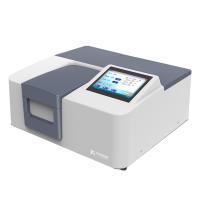
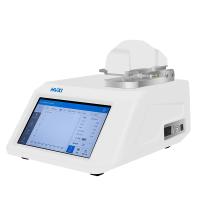
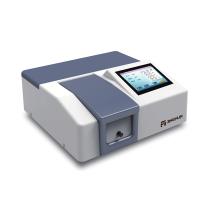
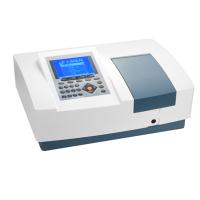
UV Spectrophotometer is a commonly used photometer product. With it, light of different wavelengths can be arbitrarily selected in the ultraviolet-visible region. The instrument has the advantages of stable performance, flexible use, high reliability and convenient maintenance. The UV Spectrophotometer needs to be calibrated before use. The following is the calibration method of the UV Spectrophotometer .
How to calibrate a UV Spectrophotometer ?
One of the important physical and chemical quantities in spectrophotometry is absorbance. In order to obtain accurate research results, it is very important to accurately measure the absorbance of the sample solution. In general, the unreliability of analytical results is related to chance and systematic errors. Accidental error affects the precision of the measurements, but it can be reduced by performing statistical processing on a sufficient number of measurements. Systematic errors affect the accuracy of measurement results. When measuring, the accurate measurement results of a substance under approximately the same experimental conditions can be compared to unify the systematic error. However, system (wavelength correction, slow astigmatism of the Spectrophotometer , linear response of the amplifier, dark current and light path of the cuvette) and operational errors of the Spectrophotometer to the measured absorbance (temperature changes, instrument readings, operator changes , the purity, weighing and concentration of the substances used, pH) can be checked and corrected. For operating errors, in most cases, strict compliance with operating procedures for measurement, instrument zeroing, accurate weighing, etc. can be controlled or reduced. The systematic error of the instrument can be overcome by regular calibration. Spectrophotometer . If high-precision measurements are required, the instrument needs to be calibrated daily.

Absorbance Calibration
Usually a certain concentration of extremely pure substance solution is used as a standard for correcting absorbance, and the absorbance coefficient of this solution is checked by different laboratories. In order to prevent the absorbance of the standard solution from changing due to small changes in the measurement wavelength, a substance with a smoother absorption peak is often selected. At the same time, the solution is required to be stable, and the change of absorbance in a certain wavelength range conforms to the Beer-Lambert law. Therefore, a solution of copper sulfate, ammonium cobalt sulfate and sodium or potassium nitrate is usually used. Potassium chromate solution is a commonly used standard solution. The solution is suitable for use in the UV and visible region.
Wavelength or Wavenumber Calibration
Solutions with narrow absorption bands, filters or vapors can be used to correct for the desired wavelength range of light. If high accuracy is required, it can be corrected using radiation emitted by a discharge bulb. Some spectrometers are equipped with a lamp for calibration. Benzene vapor can also be used to calibrate a specific range of wavelengths. Therefore, when measuring, a small drop of benzene can be placed in an absorption cup with a thickness of one centimeter, and its absorption wavelength can be measured. In the far ultraviolet region, the absorption band of oxygen can be used for correction. Various rare-earth metal filters can also be used, which allow for quick wavelength correction, but are not as accurate as the methods described above. Commonly used filters are those containing holmium, neodymium and praseodymium ions.
Stray light calibration
Small amounts of stray light tend to cause large measurement errors. Calibration can be performed with a solution that completely absorbs monochromatic light at one wavelength and weakly absorbs other wavelengths. An approximation of stray light can be deduced from the transmittance of the scheme. The spurious absorption bands caused by stray light can also be checked by the Beer-Lambert law. However, using this law to check for false absorption carries a large error. An approximate percentage of stray light can be obtained from the transmission outside the cutoff range. If more than 0.1% stray light is included, try reducing it or correcting the measured absorbance. The error caused by stray light is proportional to the stray radiation, so the correction can be easily calculated from the almost correct curve of the compound. Also, appropriate filters can be used. The filter is completely transparent in the measurement wavelength range, but absorbs light waves outside this range, thereby eliminating stray light.