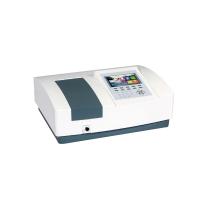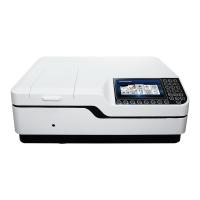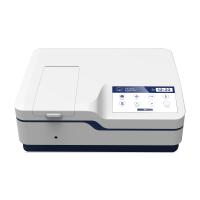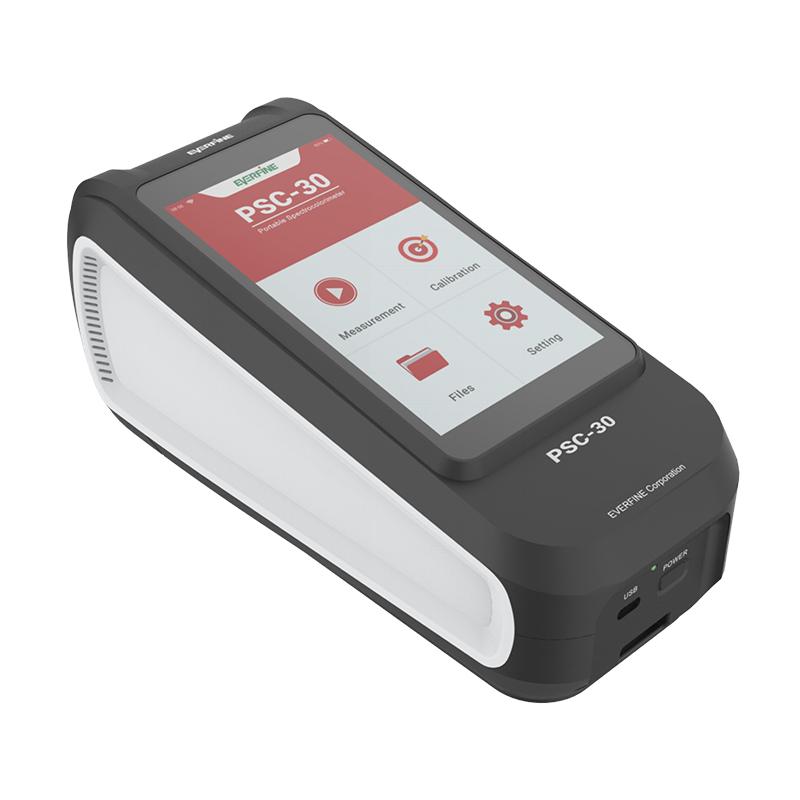
Multi-angle Spectrophotometer s or supporting angle Spectrophotometer s allow colorimetric information to be obtained at the same illumination angle and at different viewing angles. That is why these devices are often used in industries and sectors where the evaluation of metallic colors or paints, pearlescent effects or pearlescent coatings is required. That is, they are used in sectors and industries that manufacture products or use materials that undergo optical phenomena that may produce visual changes depending on the angle of observation.
Therefore, industries such as the automotive industry or cosmetics often use multi-angle Spectrophotometer s. In these industries, the importance of colorimetry cannot be overemphasized and there is a need to have a method of objectively assessing color, especially when its measurement is more complex in the products and materials they use because it needs to be done from different perspectives.
Multi-angle Spectrophotometer s evaluate color based on geometry (illumination and viewing angle), light source (type of light), and observer.
geometry
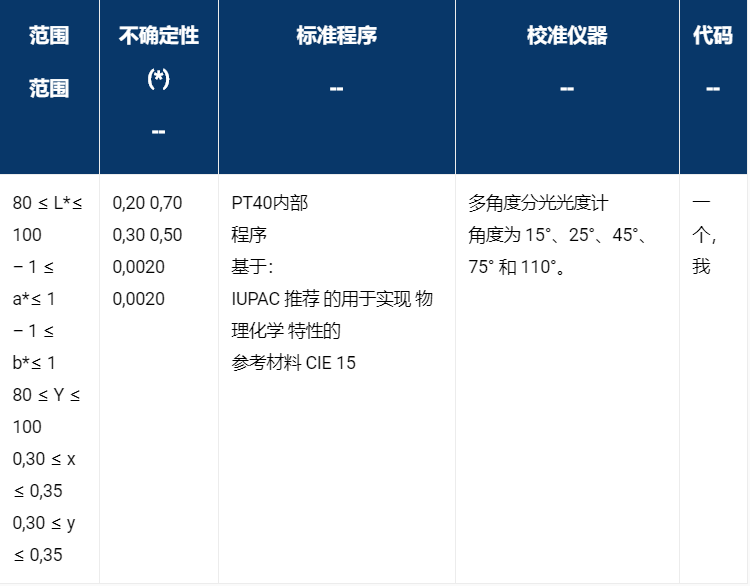
A multi-angle Spectrophotometer illuminates the sample or product under test at an angle of 45º and evaluates the light reflected at specular angles of 15º, 25º, 45º, 75º and 110º.
light source
As for the light source, we can say it is the type of light that falls on the sample whose color is to be measured. It is the spectral distribution curve of the light source.
The following illuminants are common in Colorimeters and Spectrophotometer s: D65, D50, A, and C. Specifically, illuminants D65 and D50 correspond to daylight, while illuminant A refers to artificial light and simulates incandescent light.
Other light sources also simulate fluorescent light sources, although it needs to be said that their use only extends to very specific applications or requirements in certain test regulations.
observer
In order to be able to detect and thus measure color, an observer is necessary. The CIE standardized the different types of observers, so each represents a different field of view. Specifically, CIE stands for 2º and 10º observers.
Range of calibration techniques for multi-angle Spectrophotometer s