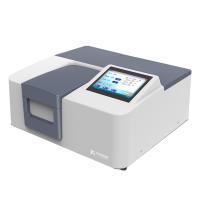
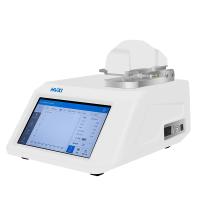
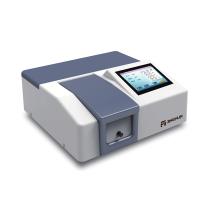
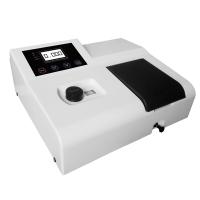
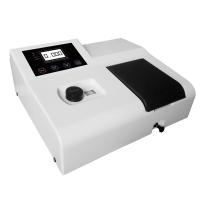
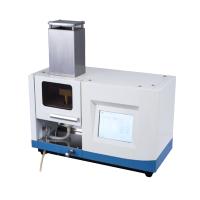
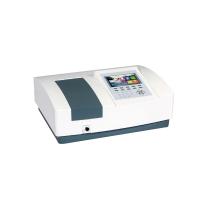
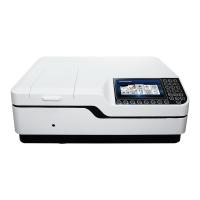
Fourier transform infrared spectrophotometry is based on the interaction of infrared radiation with matter. The working principle is the usual one in Spectrophotometer s: radiation of a certain wavelength falls on the sample and the transmitted or absorbed radiation is evaluated.
Infrared (IR) spectrophotometry is primarily based on absorption spectrophotometry and is commonly used to identify chemical species in materials. The technique can identify functional groups in organic materials, paints, and certain structures of solid and liquid samples.
The infrared region of the electromagnetic spectrum consists of three regions: the near-infrared, mid-infrared, and far-infrared. FTIR Spectrophotometer s usually work in the mid-infrared region, ranging from 4000 cm -1 to 400 cm -1 , which corresponds to 2500nm to 25000nm. Fundamental vibrations of chemicals can be seen in this region, allowing the study of rotational structures.
An FTIR Spectrophotometer provides an infrared spectrum consisting of a graph of absorbance/transmittance on the Y-axis versus wavelength on the X-axis. Typical units for the x-axis are wavenumbers in cm-1. The characteristic absorption bands of almost all functional groups are between 4000 and 800 cm-1.
ATR
ATR (Attenuated Total Reflection) is a very common technique in FTIR due to the simplicity of sample preparation and the versatility of the technique. ATR measures the change in a material when infrared radiation is reflected internally and the device produces an infrared spectrum.
The ATR technique allows the measurement of thick and opaque samples in their natural state without complex preparations. They can be measured, viscous liquids, paints, coatings, inks, plastics and more.
In IR spectroscopy, it is interesting to know at what frequencies or wavenumbers absorption peaks or spectral bands occur, and it is interesting to study the shape of the spectral bands, whenever ATR techniques are used and when they are not used. For example, the C=O group exhibits a spectral band at 1700 cm -1 , and the C≡N group exhibits a spectral band at 2050 cm -1 . If the spectral band is broad, it may be related to the inorganic group, and if it is narrow, it is related to the aromatic group.
Given the importance of knowing where the spectral bands of the analyte are located, it is useful to perform periodic calibration and verification of the equipment to ensure that the wavenumber scale is correct.
polystyrene film
Eyco can also calibrate reference materials used to validate FTIR Spectrophotometer s, such as polystyrene films. Having these materials is useful for periodic verification of equipment, comparison of various equipment within the same class, and even for internal calibration. Regardless of the application, the material needs to be calibrated to ensure the correct values.
Polystyrene film was used as a reference material to verify the wavenumber scale of the FTIR Spectrophotometer . To verify the operation of the FTIR, it is necessary to check that the positions of the spectral bands agree with the reference values.
Polystyrene has very distinct absorption bands, the identification of which is simple and well known.