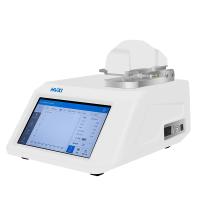
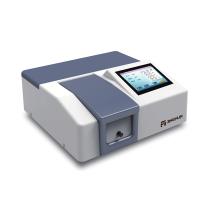
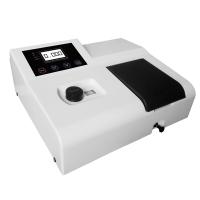
Spectrophotometry is an analytical technique that evaluates the amount of electromagnetic radiation absorbed, transmitted, or reflected by a material (whether solid or liquid) at each wavelength.
The proportion of incident radiation that is reflected by a sample or material at certain wavelengths is called reflectance and it can be diffuse or specular. In diffuse reflection, light is reflected in multiple directions, while in specular reflection, light is reflected in the same direction as the incident light. On the other hand, the amount of radiation absorbed by a material is called absorbance or optical density (OD).
For a given wavelength, the fraction or percentage of incident radiation that passes through a sample is called the transmittance. The measurement of transmittance provides insight into whether a material transmits UV light, transparency in the visible spectrum, color (in the case of translucent materials), and more. Depending on how the transmittance is evaluated, a distinction can be made between regular transmittance and diffuse transmittance. Thus, while regular transmission occurs in transparent media, allowing clear vision through them, diffuse transmission occurs when an incident light beam is diffused and transmitted in different directions.
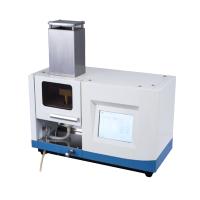
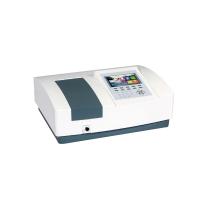
These optical properties can be evaluated and measured using a Spectrophotometer . The tests that can be performed are determined by the spectral range of the Spectrophotometer .
Testing can be performed on any type of material or product such as ceramic materials, packaging plastics, automotive plastics, eyeglasses, food liquids, oils, food and pharmaceutical packaging films, sunglasses, personal protective equipment, etc.
spectral curve
Transmittance/Absorptance/Reflectivity/Opacity
The optical properties of materials can be evaluated and characterized by the obtained data, for example, spectral transmission curves and reflection curves. A spectral transmittance curve is a representative graph of a material's transmittance based on its wavelength. A reflectance curve, on the other hand, shows how reflective a material is for different wavelengths.
In this way, it is possible to assess whether a material allows UV light to pass through or blocks it, or whether a material reflects infrared light, or also determines the transparency of a product, etc.
It is possible to determine transmittance or reflectance coefficients from spectral data and curves, determine color coordinates, etc. according to different standardized tests.
Regular, Diffuse, and Specular
Transmission is the phenomenon in which light reaching an object passes through it. Regular transmission occurs when light passes through an object with no change in direction or light quality. Diffuse reflection, by itself, occurs when light passes through a transparent or translucent object, which, due to its physical properties, deflects the beam in multiple directions.
Light Reflectance Value (LRV)
The amount of light reflected or transmitted by a material, product or surface in the visible part of the electromagnetic spectrum, from 380nm to 780nm, is called light reflectance and transmittance.
These optical properties refer to the way we perceive the color of a material, whether it is opaque - we would say reflectance - or translucent - we would say transmittance.
The weighting of spectral values for reflectance and transmittance takes into account three aspects: the response of the human visual system under photopic conditions, the illumination used, and the geometry of the observer. Considering these three aspects, light transmission and reflection coefficients are obtained.
Different regulations exist for measuring these optical properties that apply to specific products and indicate the guidelines to be followed when measuring reflectance or transmittance and calculating luminescence factor.
Haze or Turbidity Measurement
Haze is the scattering of light in a transparent polymer, giving it a cloudy or whitish appearance. This is the percentage of transmitted light that is scattered more than 2.5º from the direction of incidence of the beam.
Haze measurements provide information on the amount of scattered light passing through a transparent sample. Therefore, if the surface or substance has many irregularities, the haze value will be higher and objects seen through the material may appear less clear and distorted.
Solar Reflectance Index (SRI)
Taking into account the hemispherical reflectance of radiation integrated in the solar spectrum, the ability of a material to reflect solar radiation can be assessed by measuring the solar reflectance. Specular and diffuse reflections can be included in this type of evaluation.
Building materials for optimal thermal insulation of buildings, or plastics used in agriculture or glass used in construction, to name a few, need to take into account factors such as the transmittance or absorption of solar radiation. High values in solar reflectance measurements correlate to low transmission or absorption of solar radiation.
The solar reflectance index (SRI) of a material can be obtained by evaluating the solar reflectance as well as the emissivity of the material. The emissivity of a material is the ability of the material to emit infrared radiation.
hot
Availability or thermality to infrared radiation (IR) is a parameter indicative of light transmission in the infrared spectrum of a film or plastic. This parameter represents "the ability of the film or plastic used for greenhouse covering to retain the heat emitted during the night and thus control the temperature inside the greenhouse", thus avoiding excessive temperature drops that could affect crops.
This type of measurement is very useful when analyzing the thermal properties of films used in greenhouse construction. The UNE-EN 13206 standard states that this measurement needs to be performed using infrared spectroscopy. The standard also states that, for the measurement of different optical properties, an additional series of tests, such as in the case of full-spectrum transmittance and haze measurements, need to be performed on such plastics.